Eye on Safety

Since the October attack on Tree of Life Synagogue in Squirrel Hill Pittsburgh, synagogues and other institutions across the country have been working on ways to keep our synagogue schools and sacred spaces safe,at the same time as maintaining the open and welcoming community that is part of our culture and religious practice. At Temple Emanuel, our rabbi, staff, lay leaders and our safety committee have worked hard together to find the best way to do this. A community Safety meeting was convened by NH Jewish Federation,where several New Haven area synagogue presidents and rabbis shared information- what each is doing to be prepared, and to mitigate risk. In addition, the Federation is prepared to act on our behalf to transmit possible resources available from federal, state or local authorities, and to examine the possibility of group purchasing or other collective activities.

The principles of safety for TE are similar to those practiced by schools and other public institutions. They include thinking in advance of what we will do in the case of a threat, learning from law enforcement the best steps for safety, training our staff and teachers in best response alternatives, working together with local law enforcement to minimize risk and planning for action if ever needed.    

On the national scene, Bernhard Mehl’s Kisi organization lists several steps to synagogue safety;

  1. Develop a synagogue security plan
  2. Create a security policy
  3. Create access role policies
  4. Design a plan to cooperate with local law enforcement
  5. Train synagogue leaders about security
  6. Apply for a security site visit
  7.  Separate public and private WiFi use
  8. Active shooter training programs
  9. Assign patrolling staff
  10. Material and resources must be locked away when not in use
  11. Cloud-based Access Control Systems for synagogues (Private WiFi Network; access control)

TE has already taken most of these steps, and is in the process of examining and adopting several others. Special thanks to our Safety Committee, led by Max Case and Michael Shanbrom. As you see some of our changes for safety, including electronic surveillance of our building and environs, keeping our doors locked, having congregant volunteers serve as safety monitors during school and religious service hours, and encouraging Orange Police to know our building, our schedule, and do periodic sweeps of our property, let us know if you have observations or ideas that may help us all feel safe at TE.

President’s column (September)

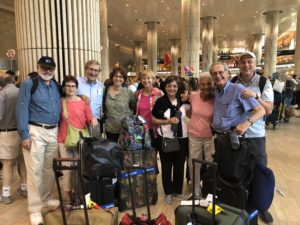
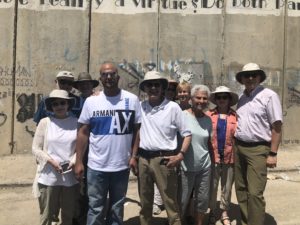
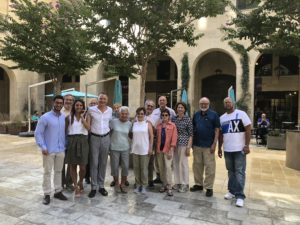
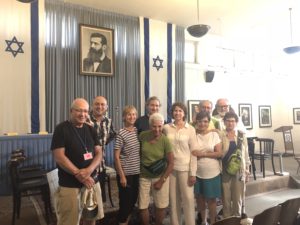
A small but hearty group of TE members, along with Rabbi Michael Farbman, visited Israel in July. Our guide was an Israeli kibbutznick, originally from South Africa, who immigrated to Israel in the Apartheid era to seek a more morally balanced Jewish life. Julian Resnick took us to many common tourist sites in Israel, and also to several West Bank locations, where we met and spoke with several Palestinians of various backgrounds – including a reporter for Time magazine, a Palestinian policeman, and a Palestinian billionaire developer. This remarkable man has built a city near Ramallah for upper middle class living, which looks like planned cities in the US including modern apartments, shopping areas, playgrounds, pools, theater. There are already 4,000 people living there, and clearly a growing market for this life. His vision is to help resolve Palestine’s current dilemma of victimhood by looking forward with more jobs, more financial success and more stability for Palestinians and Israelis.
It became clear to us that nobody wants continued Occupation – -often victimizing Palestinians and forcing Israelis into uncomfortable moral positions. However we learned that the situation is very complex – – Israel must defend itself, as Hamas encourages destitute Palestinians to confront and attack Israel. It is in Hamas’ interest to maintain the desperate condition of many destitute, displaced Palestinians, who blame not Hamas, but Israel.    What is the way out? Helping develop a Palestinian infrastructure, and a vision of hope as the developer is doing, may be one such creative solution.

We then all heard of the Palestinian teen Ahed Tamimi, who as AP reported “became an international symbol of resistance to Israeli occupation after slapping two soldiers.” The soldiers initially walked away, not causing an incident. However after a video of the encounter “went viral,” and strong voices in Israel, like Cabinet minister Uri Ariel said “I think Israel acts too mercifully with these types of terrorists,” the girl and her mother were arrested and jailed. After an international outcry, they were released, and hailed as heroes in their West Bank home.

Such a complex problem – each day the IDF and Israeli leadership make decisions that are based on Jewish morality and law, and also on a commitment to preserve the safety of Israel. Israel provides electricity to Gaza, even as their citizens send flaming balloons and kites into Israeli lands to burn their crops and possibly their homes. Israel sends humanitarian supplies across to Gaza, even as Hamas will not recognize that these life-saving supplies come from Israel.

It seems to me that the more secure and successful Palestinians can be in creating a successful Palestine, the more secure Israel can be with their neighbors in the West Bank. As long as people look back and maintain the cycle of domination and victimhood, there will be only anger, violence and sympathetic figures like the teenage Ahed Tamini. When Palestinians and Israelis look to the future and not the past, with efforts to support Palestinian autonomy, security and economic success, the space for a way out of this longtime tragedy may appear.

Life, Liberty and the Pursuit of Happiness

In the seven weeks between Pesach and Shavuot, we count the Omer – – each day counting the days with a ritual prayer. The Omer was an ancient measure of grain. In the days of the Temple in Jerusalem, Jews brought a barley offering to the Temple on the second day of Passover. The Torah commands that after that day of offering the grain, “you shall count off seven weeks.” It is interpreted as a period of growth and introspection in preparation for Shavuot.
These seven weeks are a bridge between Pesach, where we retell the Exodus from Egypt, to Shavuot, when we celebrate the giving of the Torah at Sinai. As described by Rabbi Daniel Syme, Jewish mystics see this period as joining the Jewish people’s physical (Pesach) and spiritual (Shavuot) redemption.

I have an easier time thinking about the physical part – – freedom from slavery, freedom from want, and freedom from persecution, that many of us discussed at our Seder tables. In our modern American lives, our constitution says, “We hold these truths to be self-evident, that all men are created equal, that they are endowed by their Creator with certain unalienable Rights, that among these are Life, Liberty and the Pursuit of Happiness.”


So we believe our right is to pursue happiness. It is clear how we pursue physical happiness: models of the wonderful life abound, from TV ads, to electronic media. What shoes do our superstars wear? What suits do our president and his cabinet buy? Seaside homes, fast cars, vacations abroad.


I understand less well the spiritual part – – our American vision to pursue happiness is different than perhaps a vision to pursue fulfillment. Does happiness include spiritual growth and fulfillment?


One of the meanings of Shavuot is “oaths.” The day God gave us the Torah, God swore eternal devotion to us, and we in turn pledged everlasting loyalty to God. Unlike our constitution’s guarantee to pursue happiness, the Torah commands us to be holy – – to live by God’s laws, and thereby find spiritual fulfillment. If there is a spirit, and developing that spiritual life to fulfillment is spirituality, I find my spiritual life more ephemeral and challenging. I am working to help understand the meaning of my loyalty to God and God’s devotion to me.

In the period between Pesach and Shavuot, connecting the physical to the spiritual, I wish each of you a fulfilling journey.

World of Polarization

Are you a conservative or a liberal? Fox News or CNN? Whom do you follow on Twitter? Are our leaders giants or goats? For better or worse, most of us have passionate feelings about who is right and who is wrong, and we look for affirmation of our opinion.

In the Jewish world, perhaps no issue invites such polarization more than the future of the State of Israel: One state? Two states? What of our ancient stake in Judea and Sumaria? What rights and future do Arabs, Palestinians, or others have? What do we feel about multiple claims on the land? On Jerusalem?  Where do you stand, and what role do American Jews have in this discussion? Even asking such questions invites finger pointing and invective. We are accustomed to taking a position, defending it, and often dismissing opponents as ignorant, morally bankrupt, and even self-hating. 

This year a group at TE has been learning together, taking a course from the Shalom Hartman Institute centered in Israel, entitled iEngage. Led by Rabbi Farbman, this series includes scholarly lectures and roundtable discussions from Israelis of different political backgrounds. We have examined Israel’s milestones and their meaning, from the Balfour Declaration describing a homeland for the Jewish people, the United Nations partition plan, the Six Day war, the Jubilee Year, and beyond. We have examined texts from biblical sources, historical documents, charters, and modern speeches such as one delivered months ago by Senator John McCain.

When we considered the question of Israel’s future, entitled “One State, Two States: Moral Red Lines,” we examined the proposition that we might come to the discussion from a different position: leave behind what you “know” to be right, suspend identifying with which pole of the debate you stand on. Instead, consider seeking agreement on the moral principles that should undergird any solution. We considered five moral values: the value of human life, the right to property, the obligation of reciprocity, the “right” to collective rights, and the obligation to pursue peace. We were urged to discuss and consider each of these principles, through the writings from biblical times to the present, which might guide a best solution – be it a one state, two state, or other best solution to Israel’s future.

This has been a wonderful challenge: we have much to learn from our Jewish texts and heritage that inform our moral foundation. What principles can we agree to, whatever our political orientation? What can we imagine or create together when we can establish a common moral base? And beyond Israel: imagine the power of possibility if conservatives and liberals and proponents of all stripes could first listen to one another, agree to a set of moral principles, and then discuss how this informs the future.   


From “Rags” to… Integrity

I just returned from Goodspeed after seeing “Rags,” a musical about the Jewish immigrant experience in 1910. The story describes the experience of “greenhorns” arriving at Ellis Island in New York, fleeing a European past of pogroms, and seeking new lives, hope and aspiration in the New World. As described in the revised book, author David Thompson in a screenplay written by Joseph Stein “explores what might have happened to the families who had come to America from Anatevka (Fiddler on the Roof).”  We see the tension between holding onto old values and entering a new reality, – “What do you keep? What do you leave behind?” In this musical, we are reminded that Americans already in the country view immigrants both as “fodder” to fuel the economy and also as potential threats to take their jobs and change their culture. The resonance with our current-day xenophobia and fear of immigrants is striking.

I cried at times during this play. In my real life, as I heard the chants of “build the wall” this past year, I saw in my mind an image of all four of my grandparents, who immigrated to New York from Poland, Lithuania and Russia in the same time frame depicted in “Rags.” Like the characters in the play, my grandparents left their families and fled from oppression, fear and little opportunity to create new lives and hope for the future in America. My grandparents struggled much as the characters in the play did with a hope and vision of the future for their children and grandchildren – – my future. I have a secure and happy life, a loving family, and I was able to craft my own future without fear of hunger, oppression or religious discrimination.

I believe that my responsibility as a Jew and as an American is to do what I can to assure that others have the same opportunities and protections that my grandparents received when they sailed into New York harbor three generations ago allowing my parents, sister and our whole happy family to thrive.  Temple Emanuel supports JCARR, the Jewish Community Alliance for Refugee Resettlement. This was one of the agencies that received our High Holiday Appeal support. JCARR welcomed three families to our community this past year, two from Syria and one from the Democratic Republic of Congo. My wife Joan and I will support JCARR this Hanukkah. I hope you might take a few moments to think about your own family’s history and our collective Jewish community history, and support JCARR and other organizations that welcome and support immigrants to our wonderful country.


Excerpt of President’s Comments, Rosh Hashanah 5778

5777: what a year at TE, with weekly services, Mussar, scholars in residence. Our TE religious school is thriving. Our membership is growing. Tikkun Olam projects supporting our greater community. Our grounds and gardens have never been more beautiful. Our Caring Community committee works tirelessly to offer outreach and support. We have an active Mens Club and Sisterhood. This was a fabulous 5777 inside our Synagogue – –

The year outside TE, in the larger community was less optimistic: a divisive national election with no coming together after the inauguration. Leaders of both major political parties little respected, and held in contempt by a majority of Americans. What a stark contrast in behaviors and attitudes – – comparing outside to inside our TE community.

At Shavuoth last May, Rabbi Farbman asked our 8 young men and women celebrating their confirmation, to write and speak about what Judaism meant to them. In an outside world of egos, ambition, unprecedented wealth, and division, these kids thought and talked about their Judaism. Here are some of their words. Sam Steigbigel said, “My Judaism is an obligation to myself and those around me to look at where I am, look at where I want to be as well as how I can get there without straying the path.”

Jonathan Schachter said, “Judaism is living in everlasting gratitude for the gift of life, the blessing of opportunity, and the task set before us of igniting the spark within each of us.” Micha Aviad said, “My Judaism is activism. The most important thing I’ve learned is that history repeats itself. Especially in times like these, our voices matter.” Skylar Korman said, My Judaism is my identity… It is important for me to hold onto my beliefs and stay strong in them.” Avital Sutin said, “Having a sense of Judaism everywhere offers me a moral compass in my daily life, from pursuing justice and peace, treating other people how they deserve to be treated, and being kind to my physical surroundings.” Julia Katsovich said, “Judaism’s values taught me and instilled in me the importance of being generous and kind, and I want to be able to say that I have made a difference in people’s lives somehow.” Sam Farbman said, “Life within these walls is vibrant and treasured, a rare commodity in a world that often seems bleak. The things I’ve learned from the Jewish people who surround me on a daily basis have expanded my understanding of humility, gratitude, and commitment.”

As I look to this new year, I will try to remember the inspiring words of our wonderful young congregants. At Temple Emanuel, exploring our Judaism together, we have the opportunity to recognize and share gratitude, to be generous and kind, to pursue justice and peace, and to remember that in times like these, our voices matter. May the example we set, and the lives we and our children lead, be models of what the world can be.

Days of Awe on the horizon.

My first summer as TE’s president has been relatively quiet. School is not in session, summertime services have been beautifully planned and led by fellow congregants, and Rabbi Farbman and the Spain travelers have returned from what they say was a fabulous trip.  I am acutely aware, however, that these lazy, crazy days of summer are numbered… the High Holidays have appeared on the horizon, and I feel we are racing toward them at light-speed.

Our tradition teaches that these holidays, and the Days of Awe between Rosh HaShanah and Yom Kippur, are most meaningful for us if we prepare for them in advance. How are we to take time and focus away from our daily chores and activities to prepare for examining our behavior over the past year, recognize our shortcomings and misdeeds, and seek a way to come closer to God?

Our tradition suggests that during the month of Elul before the High Holidays, God is particularly accessible. I thought about this recently when I visited our cemetery, and read the headstones of so many of my friends, mentors, colleagues, fellow congregants. At each grave, I stood a few moments and thought about each of them – what they believed, how they laughed, what I learned from each. I stood at the grave of my close friend and mentor, Rabbi Jerry Brieger Z”L. Before Jerry welcomed me into TE 40 years ago, I had no personal tradition of celebrating the High Holidays. Rabbi Brieger’s gentle yet learned style enticed me to participate in these traditions, to reflect on what I had done and who I wanted to be, and to prepare for a new beginning as the new year was born. That first Rosh HaShanah and Yom Kippur for me was really the first time I had spent much time thinking of my accomplishments, my mistakes, my regrets, my hopes and my relationship with my fellow humans and with my God. As we completed the day of fasting and prayer on Yom Kippur, as one community singing together, the wonderful surprise I had not anticipated was my sense of redemption, intense love and real hope for the future.

This year, my preparation for the Days of Awe began as I stood in the cemetery with my beloved Jerry, thinking of how lucky I was to have had such a guide and loving friend. I do not know how many more Days of Awe I have on this planet. I do know that our tradition of introspection, repentance, reconciliation, forgiveness, gives me the opportunity to find again my true self, my purpose, my appreciation of all that life offers, and my hope for our future together.

I hope each of you might also have the opportunity to build again a whole heart as we prepare for the Holidays. I look forward to seeing you at synagogue.


First Days as President

I started my role as president of Temple Emanuel on July 1st. It seems to me a large and forbidding task; the little voice on my shoulder is saying, “Don’t screw it up! We have a beautiful community, an inspirational rabbi, a rich tradition, and a future full of promise… if you don’t screw it up.” I lie awake at night thinking what I can do to do this job responsibly.

I am so lucky to start this job at such a wonderful time for Temple Emanuel. Under the remarkable leadership of President Melissa Perkal and Rabbi Michael Farbman, we have been part of a renewal over the last several years. Our sanctuary and school have transformed to “one campus” with a new education wing, and we have seen growth in our school enrollment, staff, and programs. The excitement among young families with children in our community is palpable. We have financial security with a balanced budget, funds for programming and for maintaining our building and grounds. We have a rabbi who daily goes above and beyond – – with spiritual leadership, lifecycle stewardship, inspirational teaching for young and old, attention to the sick and families in need, and a vision of our potential.

Most impressive to me, we have a tradition of involvement and commitment. How do we survive – and thrive – – as a small synagogue with only one full-time employee (the rabbi), a part-time school administrator, and part-time teachers, caretaker, bookkeeper, and office administrator? We succeed because so many members take an active part in our synagogue life. Our Board of Directors brings experience, wisdom, and excitement to our strategic thinking and planning for our future. Working groups or committees do great work with Caring Community assuring attention to families in need or transition, Ritual Committee working with the rabbi to craft our community practice, Building and Grounds doing all the work to keep our spaces functioning and safe, Garden Committee creating and maintaining our incredible expanding, beautiful garden, Aesthetics assuring a beautiful and appropriate space, Finance managing our precious dollars, Education for both children and adults, Tikkun Olam fulfilling our commitment to giving… and many more. Individual members find joy and friendship working together to keep TE our spiritual and community home.

Why do these committed members do it? I thought about this on the mid-June afternoon following our annual meeting. Directed by Anne Eisner, dozens of men, women, and children working in 90-degree heat moved large stones from a high pile behind the sanctuary to their new home in the gardens surrounding the buildings. Others prepared a picnic for the “laborers” with hamburgers (meat-full and meat-less), hot dogs (all beef, of course), fixings, and cold beverages (including beer, of course). Why?? Fellowship, commitment, love.

If as a new president, I am able to sleep at night, it will be because I can count on the many members who make the commitment to participate. We need you!! Please find what most interests you in our synagogue life.  Join one of our working groups or committees, and share in the joy of community life. If the idea of this makes you hesitate, don’t hesitate too long… the Talmud says, “Three things are good in a little measure and bad in large: yeast, salt and hesitation.” (Berakot, 34a)  As I look out on the next years for TE, I see promise, excitement, and a spiritual home alive with young laughter, learning, and strong community.

Alan Kliger

Change, Commitment & Continuity—A Tale in 3 parts. Part 3: L’dor v’dor


Melissa at BiennialChange:  Amazingly, this is my last column as I finish my term as President at Temple Emanuel.  It has been a privilege to serve, and moreover, to have one’s service accepted. I am humbly grateful to Temple Emanuel for the sacred opportunity to have helped lead TE over the last three years. In addition, it has been three years of change and growth. From completion of the Jonas and Barbara Miller education wing, to the replacement of the old HVACs, and placement of the solar panels, we have done lots of work on the physical plant of our TE home. We have strengthened our school with a part time director, improved our bookkeeping system, and started our Federation Endowment and Legacy funds. Even more importantly, we have added families, staff, and programs that make our TE home a place where people want to come, learn, share, and experience Judaism.

Commitment: Without the commitment of our many TE members over these last several years nothing would have gotten done. I would like to acknowledge with deep appreciation the truly generous support I have gotten from my fantastic fellow members as we have journeyed together. A very smart editor of the Shofar once counseled me that if I list names, I will undoubtedly leave off one or two of the most important. I have tried to heed her warning. But, I can say that I have been blessed by the amazing help of the TE Board and officers, the Rabbi, the director of the school, the bookkeeper, the office administrator, and the caretaker. But it is all the other members who teach, head events, champion causes, raise funds, do publicity and communications, create beauty (outside and in), cook, schlepp, and otherwise provide the real hands on work that I am most grateful to. We are a community of “do-ers”.

Continuity:  I am optimistic that we are a growing community on the move. Come help be part of that energy that moves us.  The Annual meeting is on June 11; besides the bagels, you will have the opportunity to voice your opinion and vote for the budget, the slate of officers, and the new Board members for the coming year. It is a group of individuals that are ready and able to continue our success. L’dor v’dor