 A special kabbalat Shabbat with TE band, Israeli dancing with Asya Tibi and a special Israeli dinner organized by our very own Rachel Sutin and Iris Back!
Register today – you don’t want to miss this!
A special kabbalat Shabbat with TE band, Israeli dancing with Asya Tibi and a special Israeli dinner organized by our very own Rachel Sutin and Iris Back!
 Mindfulness & Sound – A Jewish experience program for children! (Parents are also invited to join!)
When: Sunday, April 29th
Where: Temple Emanuel, 150 Derby Ave, Orange, CT 06477
Celebrate Spring with PJ Library and your friends as we listen to our own rhythms and the sounds all around us in new ways. This way of listening (SHMA) embodies the Jewish value of Peleh – Wonder.
Program includes a story, movement and singing.
Preschool: 10:00 – 10:30 am (followed by snack)
Grades K-2: 11:00 – 11:30 am (join us for a quick snack at 10:45)
11:30 – 12:00 noon – You are welcome to stay and experience Temple Emanuel Religious School for the rest of the morning!
Questions? Contact Stacey Battat of PJ Library pjlibrary@jewishnewhaven.org 203-387-24243, ext. 317
or Olga Markus, Temple Emanuel Religious School Director school@tegnh.org 203-397-3000, ext.3
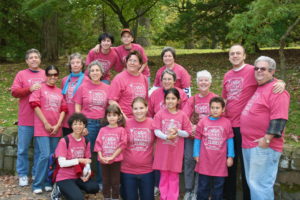
Join the official Temple Emanuel Team for the CT Food Bank Walk Against Hunger on April 29 at 1pm at Lighthouse Point Park, New Haven. You can join the team, walk, or donate to support our efforts here.
Help us reach our Walk Against Hunger fundraising goal of $1000! What an exciting opportunity for us to work together to provide nutritious food to people in need.
Join the Temple Emanuel Team at Lighthouse Point Park to rally in support of the Connecticut Food Bank and its network of local food assistance programs to make a difference in the lives of neighbors in our community facing hunger.
Please consider walking with me or supporting my team. With your help we will be able to make a difference in our local community and in the fight to alleviate hunger. I hope you will encourage your family, friends and coworkers to get involved too!
Why Walk Against Hunger?
More than 400,000 people in Connecticut struggle with hunger. One in six Connecticut children is food insecure. It’s a problem affecting not only our cities, but suburbs and rural communities across the state. This spring, the Walk Against Hunger will bring attention to their challenges and raise funds to put more food on their plates.
More than 650 community based food assistance programs depend on the Connecticut Food Bank as a lifeline to nutritious food. Through this network, the Connecticut Food Bank distributes enough food in the six Connecticut counties they serve to prepare more than 57,000 meals per day.
Walk Against Hunger proceeds expand the capacity of the Connecticut Food Bank to provide nutritious food to people in need. Your support helps the Connecticut Food Bank to supply shelters, soup kitchens and other hunger relief services that provide food to neighbors in your local community and raise community awareness about the problem of hunger and the need to help people right here in Connecticut.

Looking for fun with your little one? Come to the Tot Shabbat at Temple Emanuel! Friday, April 13 at 5:30 pm Tot Shabbat, followed by traditional Shabbat dinner.
 As I write this column, our nation continues to reel from the pain of another devastating school shooting, this time in Parkland, Florida, that claimed 17 lives. As always happens after such tragic events, we engage in fierce debates and discussions, in person and increasingly online, on how best to prevent such tragedies. As always, there is not much listening going on in these debates – but quite a lot of shouting. The issues are real, the pain is real, and the frustration is real. It is hard to talk about difficult issues, amidst communal and national pain, when we are so divided in our opinions. It is obvious that people are finding it increasingly hard to even acknowledge the humanity of anyone holding an opinion that differs from his own. And yet also we must acknowledge that unless we find a way to listen to each other, and to really hear each other, the solutions to this and many other of our problems, will continue to elude us.
Over the last five months some 40 plus TE members have engaged in learning about the 100 years of modern Jewish history, 1917 through 2017, through the study of pivotal events in the history of the State of Israel with the help of the materials prepared by the faculty of Shalom Hartman Institute in Jerusalem. As we deepened our knowledge and understanding of the historical events of 1917, 1947, and 1967, we also considered some of the fundamental ideas of Zionism, as well as the challenges. We were most inspired by the way multiple (and diverse) opinions were presented and debated by the Hartman faculty in the Round Table discussion of each lecture. Having dramatically different ideas, and disagreeing, perhaps vehemently, does not have to stand in a way of listening and engaging in a conversation, however challenging it may be.
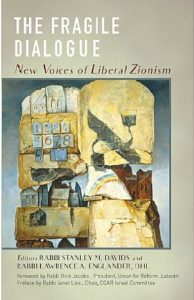
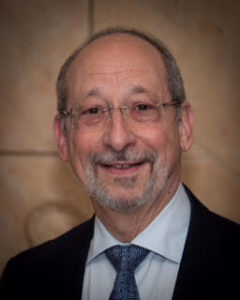 As you will see elsewhere in the Shofar, our Scholar in Residence this year is Rabbi Larry Englander, a wonderful teacher and a colleague, who co-edited the recently published ‘The Fragile Dialogue: New Voices of Liberal Zionism,’ a collection of essays presenting a wide variety of modern liberal Zionist ideas and challenges. While we will have an opportunity to learn so much from Rabbi Englander during his time here (see the full list of events in the Shofar and online), I am particularly looking forward to continuing our conversation on how to have these ‘fragile dialogues,’ addressing some of the most difficult, most challenging questions of our generation. I look forward to this continued journey of learning and listening with all of you and with Rabbi Englander on April 12-14, as well as during a special session on April 8th where we begin to look at the ideas presented in the book. In the meantime, I wish you a Chag Pesach Kasher v’Sameach – Happy Passover, and I look forward to seeing many of you at the TE Seder (first night, March 30) and the Passover Morning Service on March 31st.
‘The Fragile Dialogue’ is available for purchase at a discounted price of $15 through TE website and at the office.
 Are you a conservative or a liberal? Fox News or CNN? Whom do you follow on Twitter? Are our leaders giants or goats? For better or worse, most of us have passionate feelings about who is right and who is wrong, and we look for affirmation of our opinion.
In the Jewish world, perhaps no issue invites such polarization more than the future of the State of Israel: One state? Two states? What of our ancient stake in Judea and Sumaria? What rights and future do Arabs, Palestinians, or others have? What do we feel about multiple claims on the land? On Jerusalem? Where do you stand, and what role do American Jews have in this discussion? Even asking such questions invites finger pointing and invective. We are accustomed to taking a position, defending it, and often dismissing opponents as ignorant, morally bankrupt, and even self-hating.
This year a group at TE has been learning together, taking a course from the Shalom Hartman Institute centered in Israel, entitled iEngage. Led by Rabbi Farbman, this series includes scholarly lectures and roundtable discussions from Israelis of different political backgrounds. We have examined Israel’s milestones and their meaning, from the Balfour Declaration describing a homeland for the Jewish people, the United Nations partition plan, the Six Day war, the Jubilee Year, and beyond. We have examined texts from biblical sources, historical documents, charters, and modern speeches such as one delivered months ago by Senator John McCain.
When we considered the question of Israel’s future, entitled “One State, Two States: Moral Red Lines,” we examined the proposition that we might come to the discussion from a different position: leave behind what you “know” to be right, suspend identifying with which pole of the debate you stand on. Instead, consider seeking agreement on the moral principles that should undergird any solution. We considered five moral values: the value of human life, the right to property, the obligation of reciprocity, the “right” to collective rights, and the obligation to pursue peace. We were urged to discuss and consider each of these principles, through the writings from biblical times to the present, which might guide a best solution – be it a one state, two state, or other best solution to Israel’s future.
This has been a wonderful challenge: we have much to learn from our Jewish texts and heritage that inform our moral foundation. What principles can we agree to, whatever our political orientation? What can we imagine or create together when we can establish a common moral base? And beyond Israel: imagine the power of possibility if conservatives and liberals and proponents of all stripes could first listen to one another, agree to a set of moral principles, and then discuss how this informs the future.
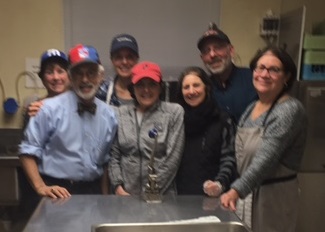
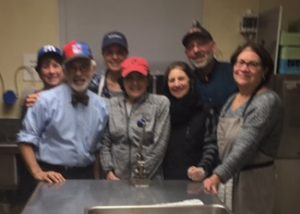 As part of TE’s social action program, Nancy Weber and Max Case have organized a group of TE members to serve dinner at the Beth El Center soup kitchen in Milford on the first Tuesday of each month.
Here’s how it works: We purchase a main course meal sufficient to provide for approximately 40 individual meals. The cost of the main course is not more than $100 and we are working out a system where we can all share this expense equitably over the year. Salad, bread, dessert, coffee and drinks are available from the Beth El Center’s food pantry at no charge to us.
Preparing for dinner generally takes 30 to 45 minutes and includes setting tables, making coffee and drinks, preparing salad and plating desserts. The dining area is open from 5 to 6 and our members serve dinner, clean tables and bring dirty dishes and glasses to the dishwasher.
After the dining room closes at 6, we clean up the kitchen and the dining area, put away dishes and silverware and wipe down the tables. As you might expect with any TE function there is plenty of time to socialize and catch up with each other. Depending upon the socializing and talk, we are generally finished by 6:30.
Want to join us-contact Nancy Weber or Max Case for more information or to sign up for this rewarding experience.
RABBI LAWRENCE ENGLANDER, D.H.L. co-editor and author of the recently published “The Fragile Dialogue: New Voices of Liberal Zionism” will be our Scholar-in-Residence this year.
Thursday, April 12 7 pm – 8:30 pm: Mishnah class (Open to all!)
How did we get from a centralized Jerusalem Temple to world-wide
synagogues? In our Mishnah study, we shall discover that the
synagogue was already becoming popular while the Temple still
stood — and we’ll discuss the reasons why.
Friday, April 13
Saturday, April 14
Secular Israeli rock stars are turning to Jewish tradition to find material for their songs – and in the process they are teaching Judaism to their fans! We shall listen to a few of these songs and discuss their meaning for Israeli listeners and for us.
Just as protest songs influenced political life in North America in the 1960’s, so has there been a similar tradition in Israel. In this session, we shall listen to and discuss protest songs going back to the aftermath of the 1967 Six Day War and continuing on to the present. The themes will include the Occupation, African asylum seekers, social inequality and more.
This weekend is generously supported by Anonymous TE Leave a Legacy Donor.
About our speaker
Rabbi Lawrence A. Englander received his Honours B.A. degree from York University in 1970. He then attended Hebrew Union College – Jewish Institute of Religion (one year in Jerusalem and four years in Cincinnati), receiving ordination as Rabbi in 1975. He is the founding Rabbi of Solel Congregation, Mississauga, serving there since its inception in 1973 until his retirement in June 2014; he now serves Solel as Rabbi Emeritus. He is also Adjunct Rabbi at Temple Sinai in Toronto.
Rabbi Englander received his Doctorate of Hebrew Letters from Hebrew Union College – Jewish Institute of Religion in 1984, in the field of Jewish Mysticism and Rabbinics. He has taught in the Religious Studies Department at York University and spent a semester teaching rabbinical students at Leo Baeck College in London, England. He has written several articles on Jewish Mysticism, as well as a book, The Mystical Study of Ruth, published by Scholars Press. He is former Editor of the Central Conference of American Rabbis Journal.
Another passion of Rabbi Englander’s is Reform Zionism, a subject on which he has written and edited articles. He served as Chair of ARZENU, a world-wide progressive Zionist organization, from 2014 to 2017. He is co-editor (with Rabbi Stanley Davids) of the book Fragile Dialogue: New Voices of Liberal Zionism, published by CCAR Press. He also serves on the Board of JSpace, a Canadian liberal Zionist organization.
Rabbi Englander has also played an active role in establishing two Mississauga interfaith organizations: Foodpath, a community food bank; and Pathway, a non-profit housing corporation, of which Rabbi Englander was the founding President. In 2005 he was appointed as a Member of the Order of Canada for his work in the community.
Both Rabbi Englander and his wife Cheryl are natives of Toronto.
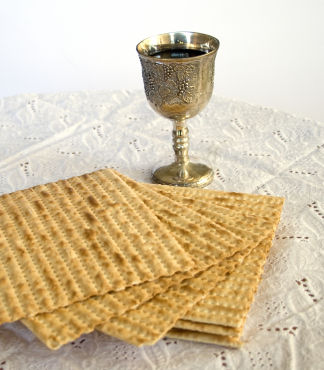
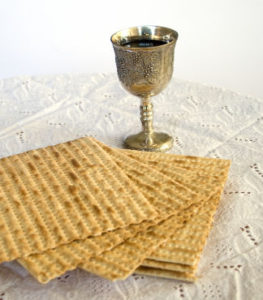 You and your family are invited to celebrate the Passover Seder with Rabbi Farbman and your extended Temple Emanuel Family!
Friday, MARCH 30 @ 6:30 PM
Members & Non-Members Welcome!
Please register by March 23 – we will not be able to accept any reservations after that date!
 Share a potluck Shabbat meal with family and friends! Unwind at the end of the week, and welcome Shabbat with your extended Temple Emanuel Family.
A Tot Shabbat service for families with kids under 5 is at 5:30pm, and a main Shabbat service will begin at 7:30pm – you are welcome to either, or just come and share the meal! Please sign up for potluck – follow the link!