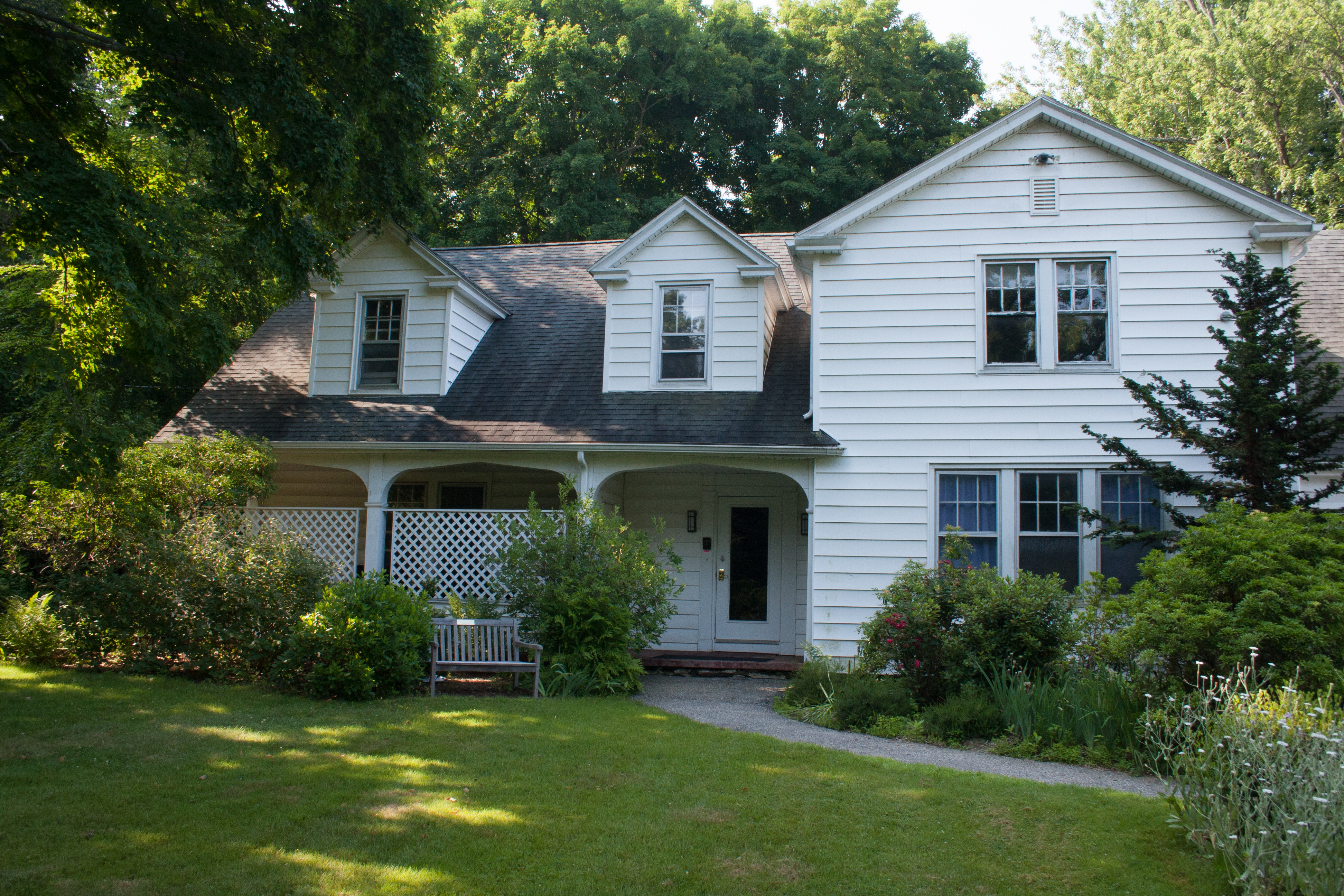
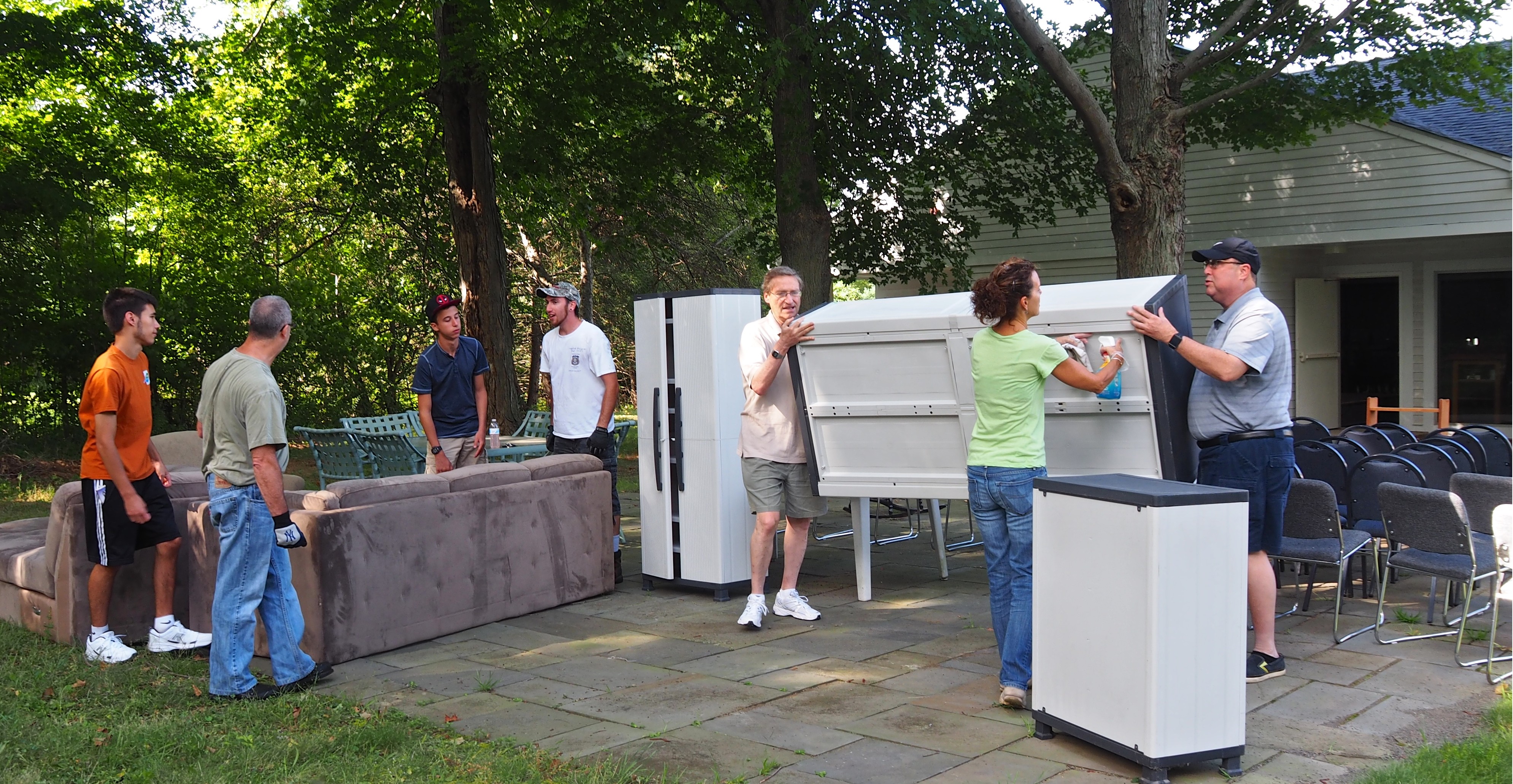
Did you know it has been ten years since the TE house came down?
Six months have passed and I still think one of the best things about being TE’s President is chatting with members of our community. One thing that always makes me smile is how folks identify their relationship with TE based on the different buildings they were in. We have members who attended events “in the barn”, others who “spent a lot of time in the house.” For anyone who joined more than a decade ago, myself included, we brought our kids to Asepha in the house, we had meetings in the house and we remember the distinction between the house and the sanctuary.
For newer members who joined in the past ten years, TE looks today mostly how it was when you joined – minus the two new classrooms near the kitchen. Some might not even know what “the barn” or “the house” means. If that’s the case, be sure to ask around and you will hear some great stories of TE’s history.
Summer 2015 was when TE moved into the expanded main building and February 2016 was when the house came down. These were momentous events in TE’s history and we feel the impact of them every time we enter TE.
The move from the old house into the new school/office wing
By having our school in the house and our services in the sanctuary, many in our community felt that there was a big divide, a “moat” as many called it, between our young families and the older members of our community. Our lay leaders kicked off an important project to unite TE called the One Campus Project. The goal was to bring all of TE together under one roof, so our community could learn, pray, meet, eat and interact all within one space.
I love the vision and energy that went into this project and I am grateful for those who invested so much time and resources into creating our one, united, TE building.
One thing I’m focusing on this year is to make sure that all our members feel connected to all that TE has to offer, including our amazing school and services. I want our established members to connect with our younger families and share their TE stories. If you haven’t experienced a Sunday morning Asepha in a while, I highly recommend you attend- the room is packed and the energy is perfect. I want people showing up, signing up and helping out. We all make TE the special place it is today. Lately, there have been many events that bring us all together, like the Dreyfus lecture that Ed organized with the Adult Ed committee, the Havdalah event in November put on by our religious school parents and teachers, and Chanukkah Shabbat organized by Holli, Jill and Ann.
My hope for 2026 is that we continue to appreciate the beauty of our community and come together within our TE home. Happy 10th birthday to our One Campus and united community.
One of the most visible and meaningful ritual garments in Jewish life is the tallit, the prayer shawl that many of us wrap around our shoulders during worship. At first glance, it is a simple object – fabric, fringes, sometimes stripes of blue or silver – but in truth, the tallit carries centuries of memory, identity, and intention.
The Torah instructs us in the Book of Numbers: “You shall make for yourselves fringes (tzitzit) on the corners of your garments… and you shall look upon them and remember all the mitzvot of Adonai and do them.” The tallit, with its four-cornered shape and fringed edges, is our way of literally clothing ourselves in mitzvot. When we wrap in a tallit, we symbolically surround ourselves with sacred purpose before we begin to pray.
Traditionally, the tallit is worn during morning services (Shacharit), and service leader always wears a tallit as a sign of communal responsibility. Out of reverence, a tallit is never taken into the bathroom (our tradition is spiritually grounded, but also very practical!). At TE, there is also the custom to inviteanyone who comes up to the bimah for the Torah service – whether for an aliyah, lifting or dressing the Torah, or another honor – to wear a tallit, marking that moment as especially sacred. And while both tallit and kippah are always welcome at TE as meaningful ritual expressions, they are never demanded.
B’nai mitzvah students often receive their own tallit as a visible sign of entering Jewish adulthood. Wrapped in a tallit for the first time as they are called to the Torah, they step into the privileges and responsibilities of a Jewish adult – including being counted in the minyan and standing as full participants in communal prayer. It is a powerful moment when tradition, community, and personal growth are woven together in a single garment.
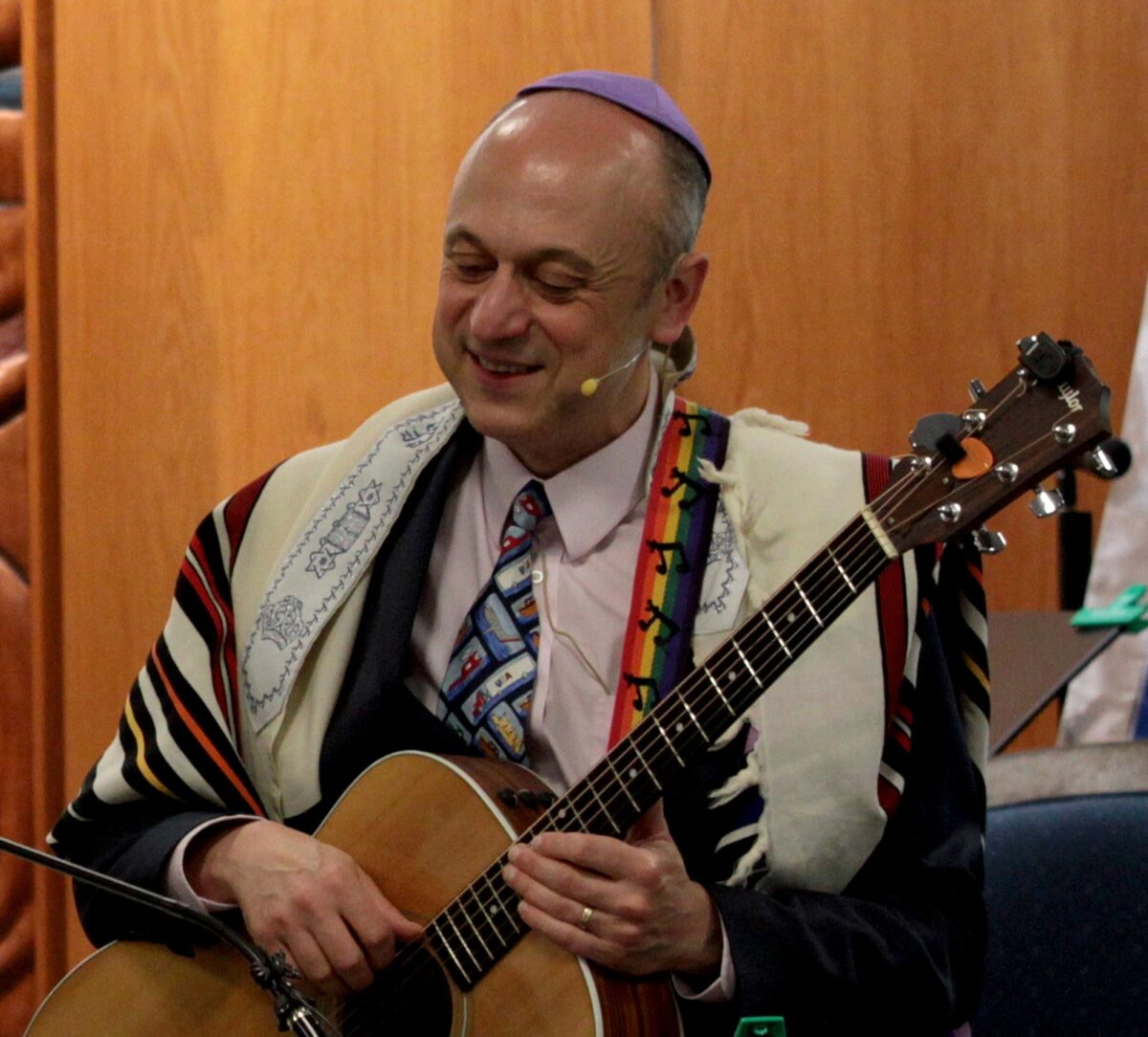
Over generations, the tallit has evolved in both design and meaning. Traditionally worn by men, today in many Reform communities – including our own – people of all genders choose to wear a tallit as an expression of spiritual readiness and personal connection. Some tallitot are family heirlooms passed down through generations; others are chosen at moments of transition – b’nai mitzvah, confirmation, conversion, or weddings. Each tallit tells a story. The multi-colored tallit that I wear throughout the year was an Ordination gift from Rabbi Winer, a garment filled with so much meaning and personal connection…
The tallit also reflects our communal values of inclusion, intention, and shared sacred space. Some prefer a classic white wool shawl with dark stripes; others wear vibrant silks, handwoven fabric, or garments created in Israeli or local artisan studios. Together, this tapestry of tallitot mirrors the diversity of our congregation itself – many paths, one community. Some of us wear a tallit every time we pray; others bring it out only on special Shabbatot or holidays. Some have one tallit for life; others mark different chapters with different shawls. There is no single “right” way – only the invitation to let the tallit become a personal gateway into prayer.
As we gather each month, wrapped in these sacred garments, we are reminded that prayer is not only something we say, but something we step into. The tallit becomes our bridge between the ordinary and the holy, between the weekday self and the soul that reaches upward. May the tallit continue to wrap each of us – and our entire Temple Emanuel community – in warmth, memory, and blessing.
For 50 members of Temple Emanuel of Greater New Haven, cleaning up trashhelps right some of the world’s wrongs
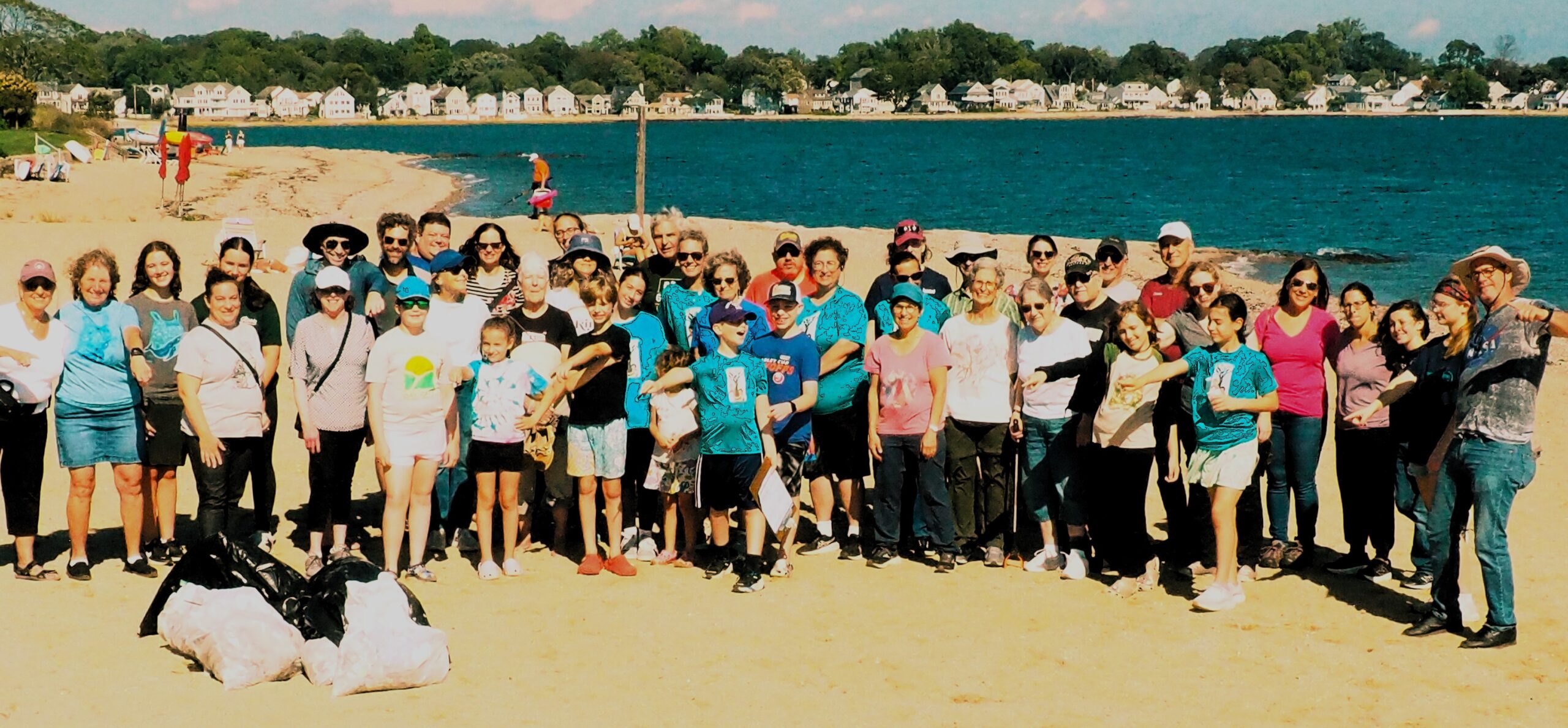
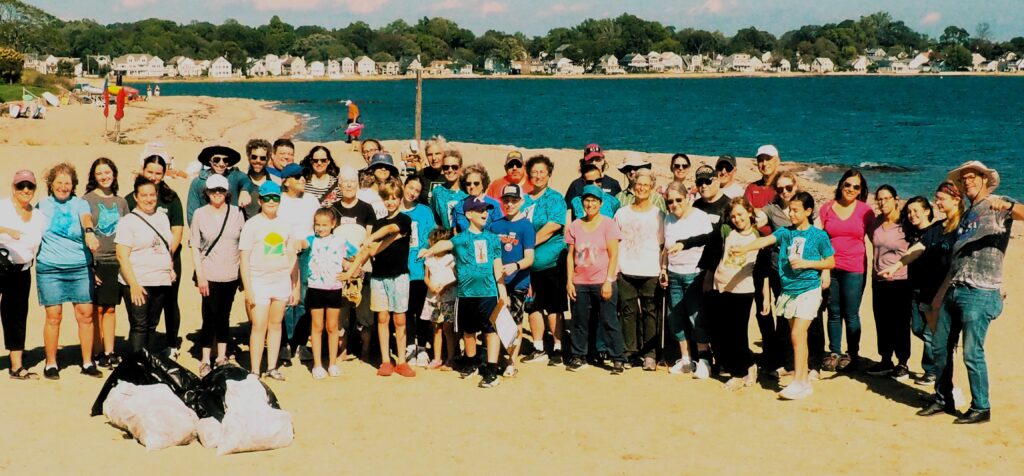
MILFORD, Conn. – It’s amazing what you can find on a beach. About 50 members of an Orange synagogue picked up a watch, a hotel key, a paring knife, sunglasses and even a pair of shorts as they scoured Woodmont Beach Sunday as part of their fourth annual beach cleanup.
“We call it Reverse Tashlich,” said Dr. Karen Fenichel, who organized the event for Temple Emanuel of Greater New Haven. “Jews have a tradition called tashlich of throwing crumbs into the water to get rid of their sins. The water is supposed to carry their transgressions away. In Reverse Tashlich, we take mankind’s sins – all the pollution people create – out of the water. It’s a great time for entire families to spend some quality time on the beach doing something good for the community.”
Fenichel works with the religious school at Temple Emanuel to assure that students as well as the adults are involved. This year, about 50 congregants and friends came together for the event. In addition, she coordinates with Repair the Sea, an international Jewish environmental preservation group; Save the Sound, a regional group dedicated to protecting Long Island Sound; and the City of Milford’s Open Space Preservation office.
“It’s amazing to think Jews all over the world this week are cleaning up beaches and celebrating the Jewish New Year by literally saving the world,” added Fenichel. “The best part is that the kids are deeply involved.”
Kids and adults moved up and down the beach in five groups, picking up trash, putting it in bags and documenting what was found. They looked for all sorts of trash. Cigarette butts were deemed particularly dangerous to wildlife because of the materials used to make them. About 183 cigarette butts were dropped into the plastic bags. In addition, Styrofoam cups, syringes, paper, fishing tackle scraps, pieces of glass, rubber material and other trash filled seven bags totalling almost 50 pounds. And the students fully understood what they were doing and why.
“The animals don’t deserve to have so much trash in their habitat,” said Ben Carmelli, 11, who tallied the trash for one group.
“This is a season when we are thinking about our actions and their impact,” said Rabbi Michael Farbman. “This is a wonderful opportunity to combine our traditions with those of the rest of the world. It also makes you think about your own actions the next time you walk on the beach.”
“It’s a way for the TE Community to give back to the wider community,” added Lindsey Sussman, temple president. “It’s a recent tradition to make the world better from generation to generation.”
byLindsey Sussman, Rabbi Michael Farbman, Olga Markus, Jeffrey Levick and Melissa Perkal
Lindsey: l’dor va’dor
My first core memory at TE was the Rosh Hashana service I attended shortly after we joined, over a decade ago. I had never been to a high holiday service and I went with a friend and her parents. My friend grew up at a conservative temple in Massachusetts and was also a new member and young mom at TE. I was sitting in a row with them and felt uncomfortable at such a big service and knowing so little. There was clearly a known orchestration to the day. As I sat there, I was in awe of how everyone knew the words, knew the order and joined in at the right times. What struck me at that moment was that generations of family members attended services just like this one, over decades and centuries, and recited the same words. Parents taught their children, who taught their children. I was jealous and impressed. I knew I wanted to be part of this tradition, to have the comfort and connection of this history and know it will live on beyond me. As my oldest daughter has shared with us, her favorite hebrew phrase is l’dor va’dor, from generation to generation and I understand why.
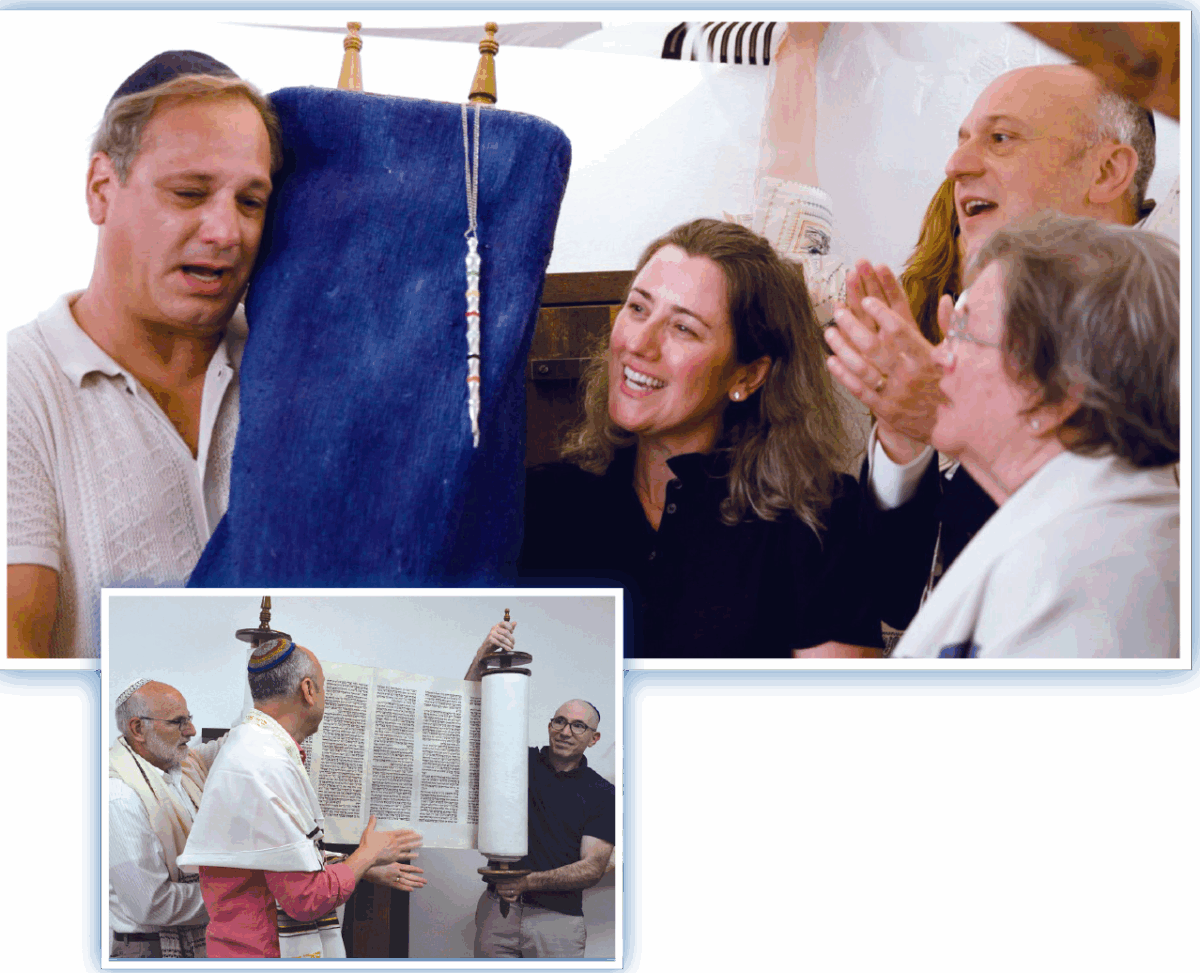
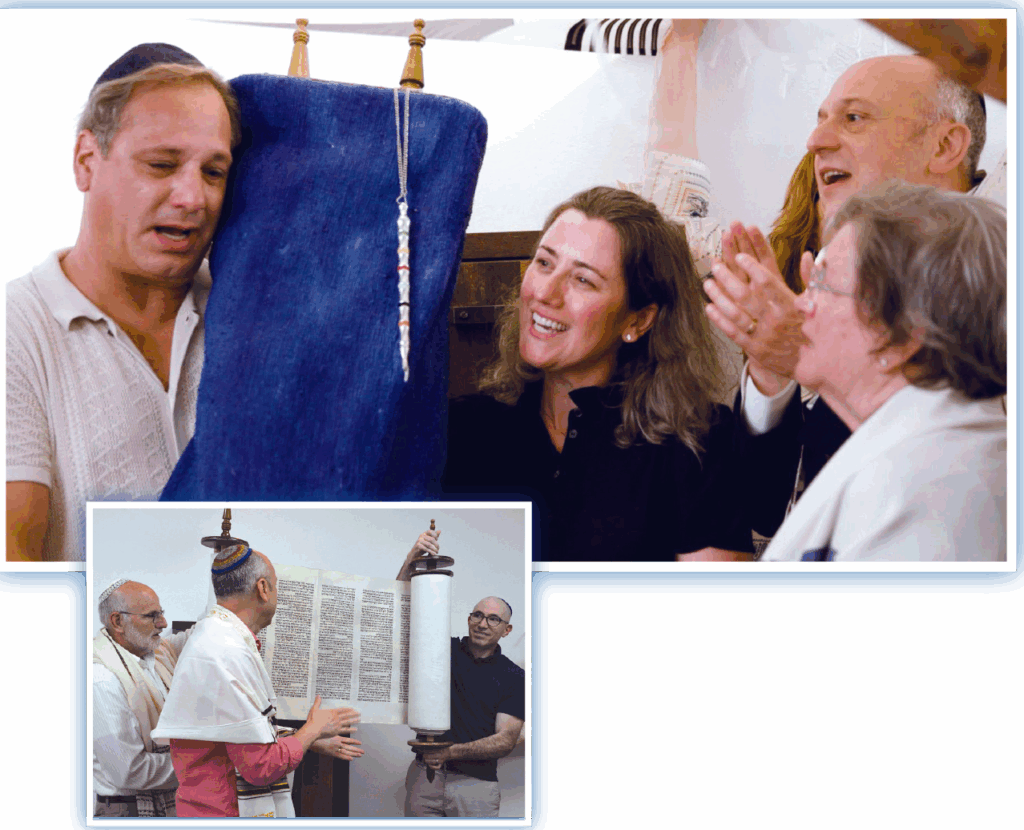
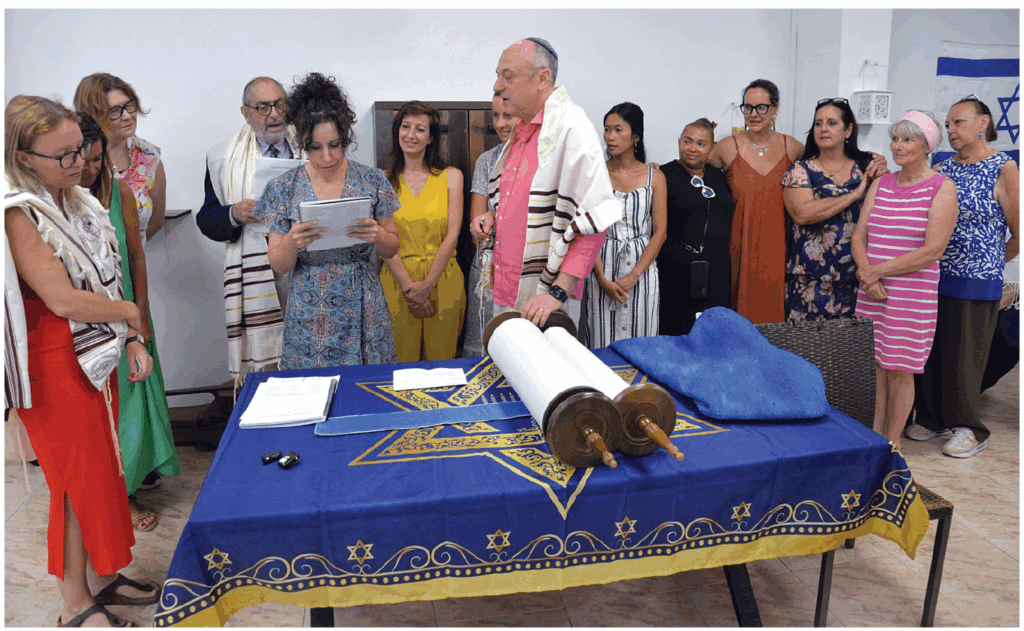
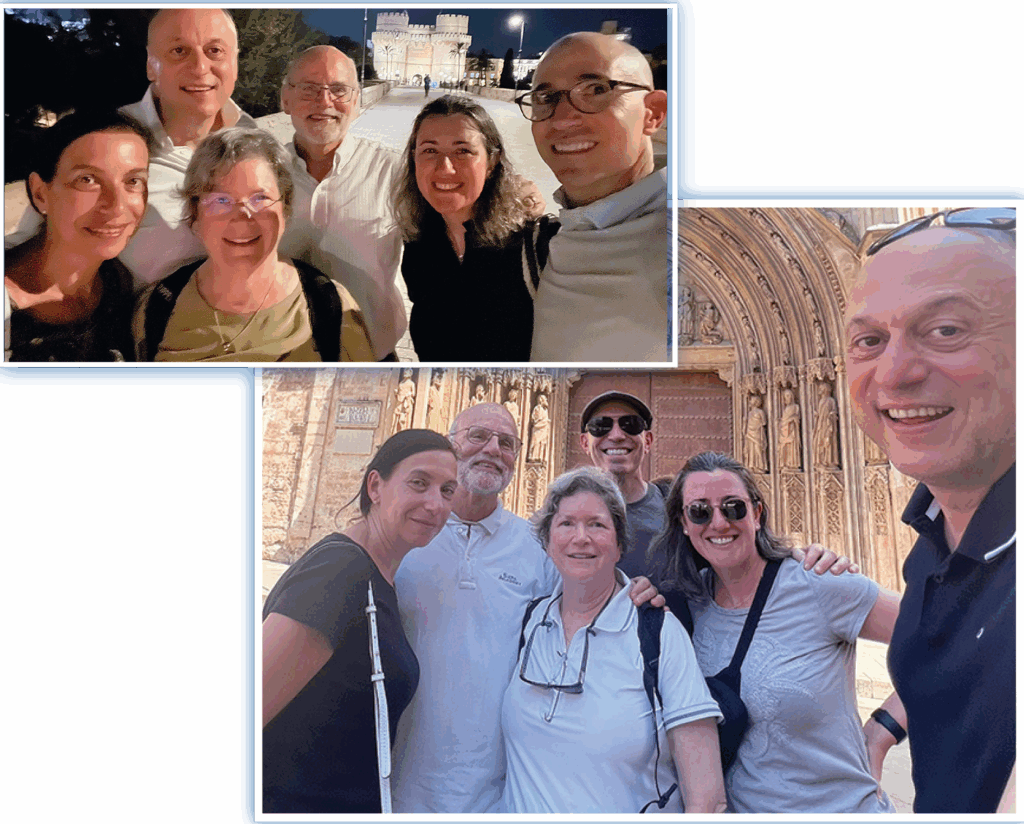
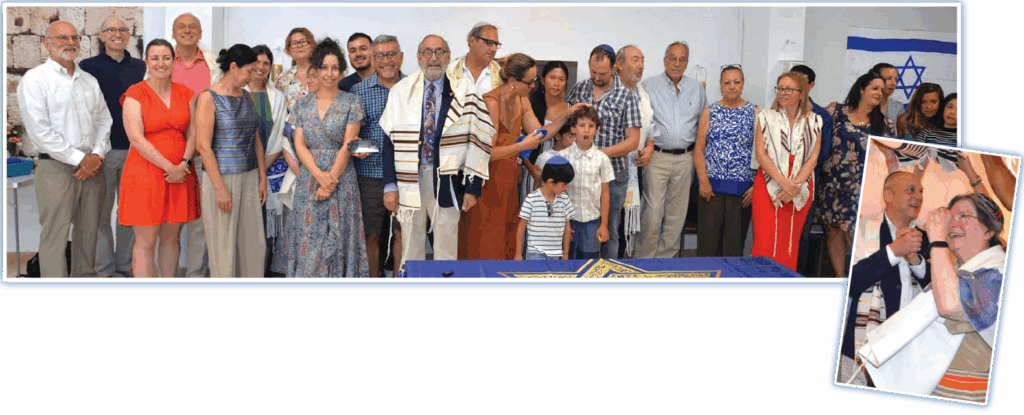
A decade or so later, I was struck with another powerful moment when a few of us had the honor, on behalf of the TE community, to deliver the gift of a Torah scroll to a new community in Valencia, Spain. Seven of us attended a Friday night service with members of Shir Jadash Comunidad. We entered an unmarked building on an industrial street. No signs or markings on the door. Inside was a large, modest space with a handful of folding chairs. Within an hour, there were at least 50 of us. Families from throughout the region, some who drove nearly an hour to attend, seniors, children, and even two families from Washington, D.C. who were in the area and heard about the congregation. While most of us didn’t speak the same language, we quickly fell into a shared experience. The service was done in a mix of Spanish, English and Hebrew. While our melodies were a little different, we were all having the same experience and knew the same words, the same flow. When Rabbi Farbman led us in Lecha Dodi on a borrowed guitar, the energy in the room expanded so quickly. You could feel it. Children were clapping along, voices were getting louder. It was amazing. The service continued with beautiful energy. Children were noisy on the floor in the corner, engaged but playing. Then after the service concluded, the congregants set up a dinner for us. Everyone helped bring out food, take care of one another. After dinner, without discussion, clean up happened, again as a group activity. Jim is sweeping the floor with one of the local congregants, Scott is folding tables, Melissa is clearing food. Our TE group was seamlessly meshed with their community, not just for the service but for the small details that make a community work.
From that unmarked building, I could close my eyes and would think I was at TE. The songs, the words, the children, the energy. This congregation is like TE at its start, and in many ways still how we operate. We function only because of the community, those who donate their time and resources to make TE run. We have a lovely building and a strong and diverse community but at its heart we are still the same. It’s the person who picks up the broom, bakes the challah, has an aliyah, speaks up, shows up, that makes our community so strong. Valencia reminded me of that, but with the added joy and curiosity of a child, still feeling things out.
Rabbi Farbman: Torah as a living document…
In the midst of the celebration, a few of us were pulled aside by a member of the community who is a local journalist, for a few moments of reflection. The language barrier made it a little difficult to communicate, but we managed nonetheless!
They asked me to talk about this moment, about bringing the Torah. I shared briefly the journey, and the challenges – making it through security at JFK with the Torah required three levels of authorization, but we succeeded. Being allowed to bring the scroll onto the plane was not an easy feat, but with a little perseverance, the willingness of Iberia staff to listen to my explanations, the letters we prepared in advance and, perhaps most importantly, the articles in Spanish press published ahead of time, I was ushered onto the plane and shown to the overhead compartment in first class, where the Torah safely traveled (while we were at the back of the plane in our seats:).
I also acknowledged that of course, the most economical way of delivering the Torah to Valencia would have been to pack it carefully and to ship it with a courier. But the most economical is not always the most appropriate or the most meaningful! Navigating all the challenges along the way, and bringing the Torah by hand was not easy – but I cannot think of a more fitting way to bring the Torah from one community to another.
As I sat in the small, hot room, I proceeded to tell them that a community needs people – without people wanting to be together and spend time together, you don’t have a community. The community can exist without the building – even though having a place to call home is very, very helpful. The community can exist without the rabbi – even though having the rabbi teach and lead the community can help transform it in great many ways.
Rabbi Alona Lisitsa is helping Shir Jadash from afar, as she is only able to travel to Valencia a few times a year, but her knowledge, her teaching, and her support enable this nascent community to flourish and continue to grow. The community can exist without the formal prayerbook – TE had famously compiled many a loose-leaf prayerbook in its early days, leading to publication of our beloved ‘blue’ Seder T’filot Emanuel, long before we adopted Mishkan T’filah prayerbook of our movement. These days, one can even project the words of the prayers onto a screen or a wall, with visual t’filah! The presence of the well-laid-out prayerbook that contains transliteration for those who are only learning their way around the service is super helpful, even if it is just a printout, but a beautiful prayerbook does not make a community.
All of these elements are important, and as I said – none of them are enough if you don’t have people who want to come together, spend time together, pray and eat together and make a living community.
You can even make do without a Torah scroll – you can study from the book, and in the absence of a Torah scroll you can even read the weekly portion from a book – although customarily people are not called up for an aliya in those circumstances. But when you enter the Torah scroll into a small rented room, and place it into the hands of a community who are thirsting for its presence, you see the instant transformation, and it is beautiful.
I was honored to stand there, to witness the tears, to add my own tears to those of others in the room, as we celebrated this powerful moment in time. It was a true blessing to get to experience this moment of joy and community.
Jeffrey Lelvick: Community
In the beginning of this year, I noticed a short blurb in this publication that mentioned that TE was donating one of our Torah scrolls to a new Reform community in Valencia, Spain, and that a small delegation of congregants were planning on taking the journey to Spain to hand off the scroll in person. As a filmmaker, I recognized a compelling story and knew immediately I wanted to document it. It had all the makings of a great narrative: a nearly 100-year-old Torah from Poland, that had already lived a long life here in the U.S., was being donated to a community in a country where Jews were expelled over 500 years ago.
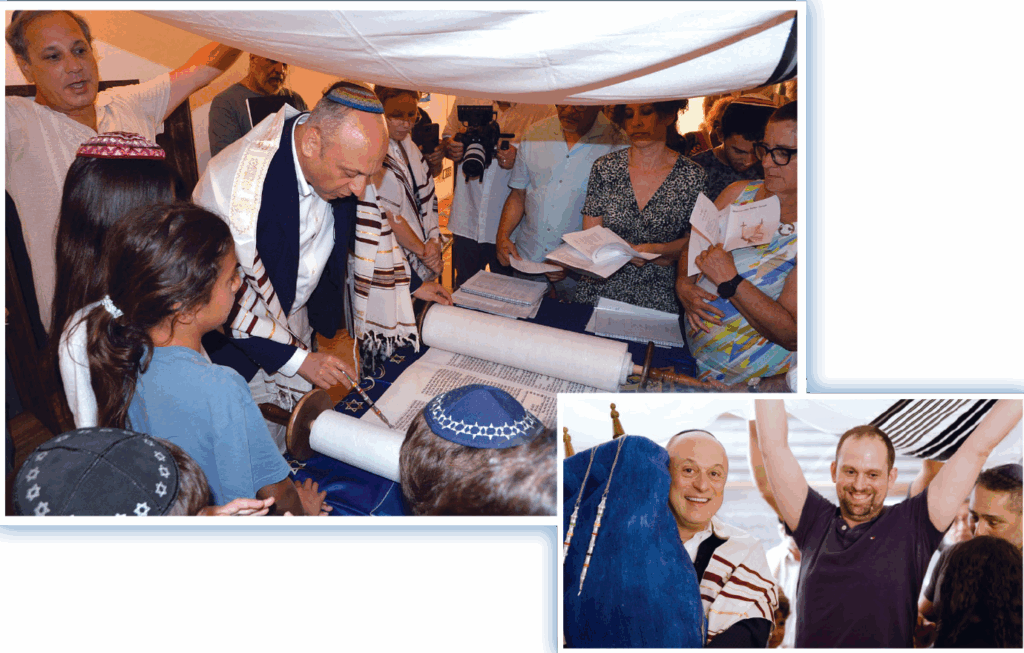
As I began filming and editing some initial footage, I was surprised to find myself welling up and crying at various points of the process. I was overwhelmed with emotion watching the scribe restore the scroll. As I recorded the Shavuot service where Rabbi Farbman read the Ten Commandments from the outbound Torah, I couldn’t take my eyes and camera off the flickering candles and the smiling faces of our fellow congregants who warmly followed along, nodding and singing during this intimate service. A few months later we did it all again, but this time in the company of our new friends and fellow Jewish travellers–the members of Shir Jadash in Valencia.
A sun-scorched Valencia was awaiting us when we arrived with the Torah in early July. And while the sparkling Mediterranean Sea and waving palm trees indicated that our humble home in Orange was far away, the community and warmth of the members of Shir Jadash felt incredibly familiar. Its members welcomed us into their small space with smiles and open arms, as if we had known each other for years. It was as if somebody started playing a vinyl record in Connecticut, lifted the stylus, and it put it back down in Spain. The language barrier was real, however, when Rabbi Farbman began strumming and singing Lecha Dodi, if there was any space between our communities, it quickly evaporated, and in that moment, we were one community, sharing our customs and hymns as they have been passed on through generations. As the president of Shir Jadash tightly held the donated Torah under the chuppah the group had created with a tallit, tears streamed down his cheek. From behind the camera, I too, choked up witnessing such beauty derived from such a natural act of providing this community an essential part of our tradition.
At various moments, I found myself wandering away from my camera to sing along and pray with the group, as if I were being pulled in by an unseen force. I’ve come to understand that force as the need for any of us–all of us–to be part of a community. I instinctively felt like I was part of the small community there and part of a much larger Jewish community during my few days in Valencia. As I spoke with the local members, who came from diverse backgrounds–from Catholics who became Jews by choice to others who had been unknowingly practicing Jewish rituals as children, I realized that they had found a community that spoke to them, that fulfilled the need to be together, to share meals, and to sustain themselves. The neshama of their community is deeply Jewish, and I’m not sure if that’s because of its diversity or in spite of it.
As I dig deeper into my footage to revisit and log what I captured, I’m struck by how much I shot of the Torah itself. From the scroll being placed in the overhead bin on the plane to being gently placed into the arc of Shir Jadash for the first time, it is clear to me that this sacred object is not one to be placed on a shelf and admired, and that perhaps the sacredness is not necessarily only from the words scribed on its parchment, but stems from the community it creates when it is unrolled and read in together in a shared space.
Olga: Pride and Joy
Pride and Joy—these are the two most powerful emotions that continue to resonate with me following our recent journey to Valencia, Spain, where we had the profound honor of accompanying a Torah scroll to its new spiritual home, on behalf of the Temple Emanuel community. As I stood before the congregation of Shir Jadash Comunidad, presenting the gifts from our Religious School—talitot and a Torah yad purchased with Tzedakah contributions from our students, families, and faculty—I was filled with an indescribable sense of pride and deep, abiding joy. What a blessing it was to take part in such a sacred mitzvah.
The weekend was marked not only by ceremony, but by a heartfelt human connection. There were tears of gratitude, hugs of friendship, and bursts of laughter that echoed across language barriers. We embraced one another not as strangers, but as a long-lost family. The shared joy, the emotional resonance of the Torah’s arrival, and the warmth of genuine hospitality created moments I will never forget.
Following Shabbat lunch, a member of Shir Jadash asked me, “How does it feel to leave your Torah scroll behind?” I paused for only a moment before responding without hesitation. I replied, “It doesn’t feel like leaving it behind at all. On the contrary—I am filled with deep gratitude and immense pride, knowing we have delivered the Torah into the welcoming arms of its new, loving, and gracious home.”
Shir Jadash Comunidad, in so many ways, mirrors our own beloved Temple Emanuel. It is a warm, sincere, DIY-spirited congregation, full of individuals who open their hearts to newcomers. Despite our different native tongues, we felt entirely at home. The bonds we formed over just a few days were real and moving.
I believe this journey marks not an ending, but a beautiful beginning—a first step toward a long-lasting relationship between our two communities. There is something indescribably powerful about standing together with fellow Jews across the world, realizing that regardless of distance, language, or tradition, we are all united as part of K’lal Israel—the sacred and enduring global Jewish family.
As for me, I will carry this unforgettable experience in my heart, and do my best to share its spirit and meaning with all of you. Am Yisrael Chai—the People of Israel live!
Melissa Perkal: Joy
For me, my love of being Jewish is the joy. The joy of community, the joy of song, the joy of meals shared, the joy of prayer, the joy of being able to give back to those who need it, the joy of learning, the joy of shared experiences. Sometimes, that joy seems to go underground and become dulled by unthinking repetition. The trip to Valencia and Shir Jadash Comunidad was a return to joy. It was a profoundly joyful and rejuvenating experience. So many of the trip’s details have been shared by my fellow travelers, so I won’t repeat them here. I think my newest task is to help re-ignite the joy here at home. It’s made even more exciting by finding a community in Spain that reflects that joy back to us and is ready for us to return to them at any moment.
For most Jews, the Torah elicits a variety of feelings and meanings. The scrolls we use in our worship services teach us the lessons and history of the Hebrew people. Some think of the Torah as the divine word of G-d, others feel it is a chronological history of the beginnings of a people.
When the ark is opened and the Torah scrolls are revealed we can look in awe. It awakens a spiritual longing in many as well as a deep connection with who we are and what we are called upon to do. However, we relate to the text it is a symbol, perhaps the primary one, of our identity.
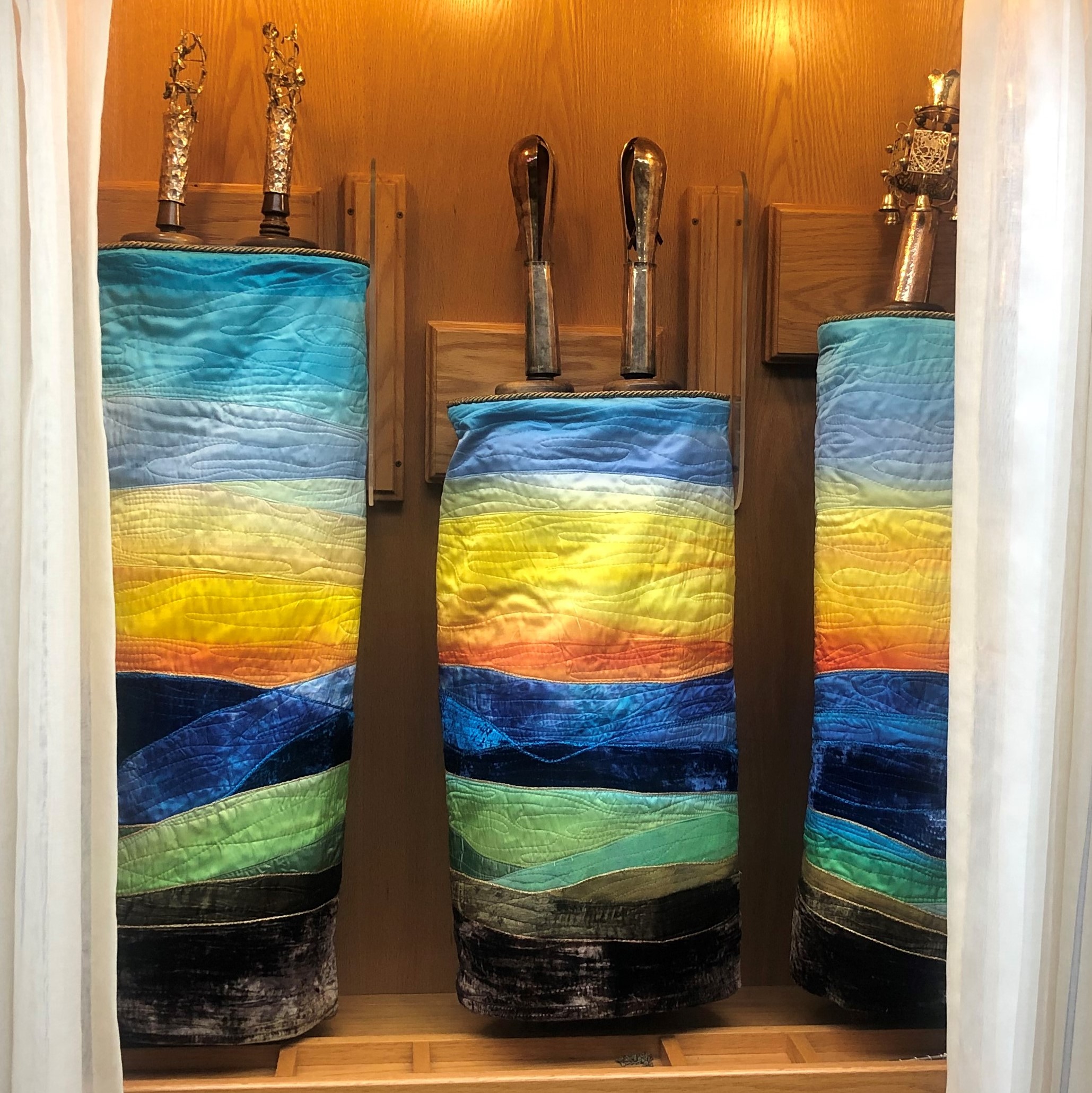
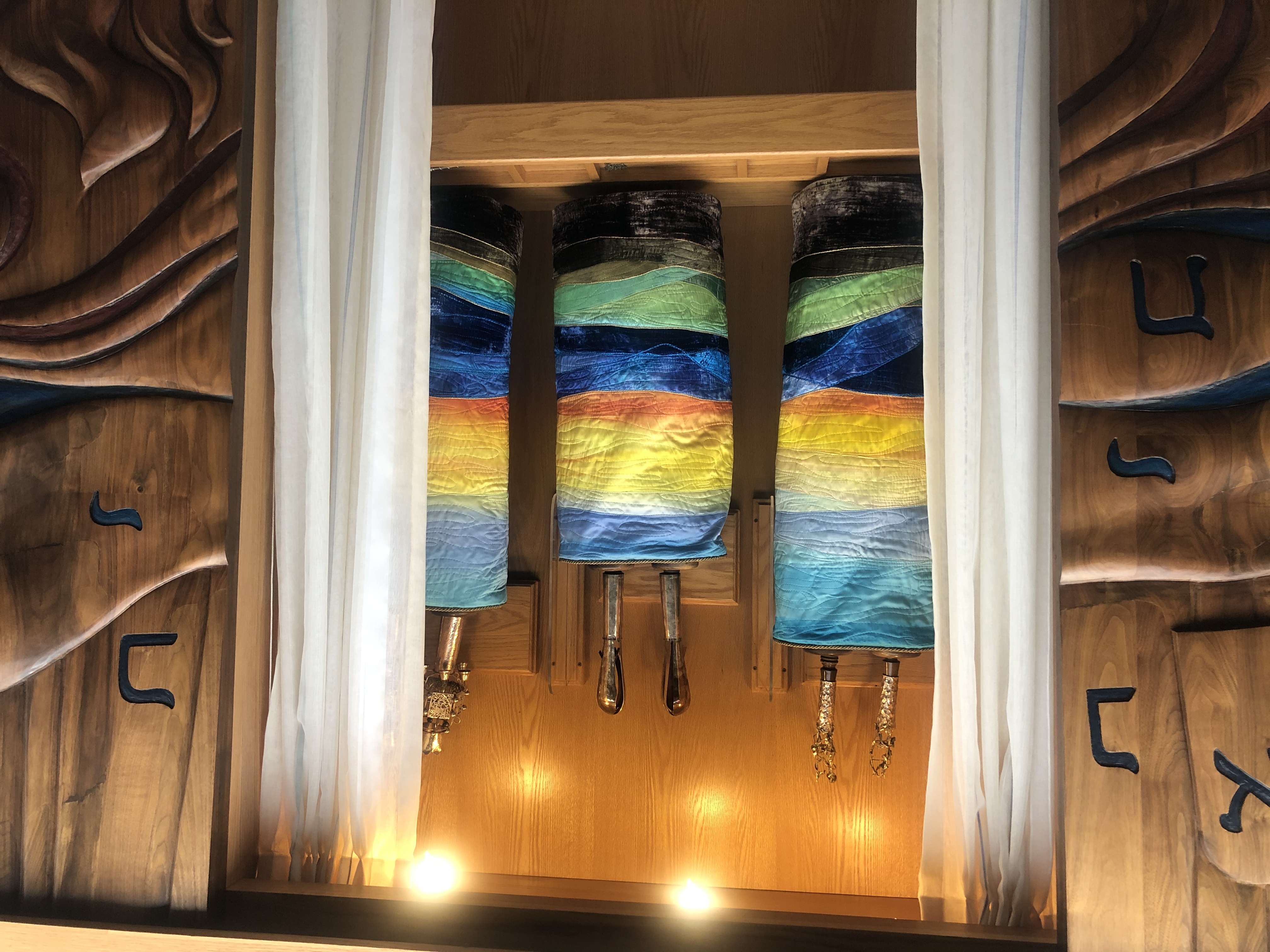
Temple Emanuel is currently home to five Torahs. Some we know a piece of their history and some we are less knowledgeable about. The following is a brief history of our Torah scrolls.
When Temple Emanuel first came together as a community in 1962, we did not have a Torah of our own. Instead, our student rabbi, Robert Goodman, would use a borrowed scroll when needed. In 1967, using our first Torah he performed a triple bar mitzvah for Andrew Levine, Jeff Lipson and Danny Salzman at the JCC in New Haven. TE had just acquired its first Torah, the Holocaust Torah.
Memorial Torah Scroll #1178
Written in 1880, the Holocaust Torah was used in Horazdovice, Czechoslovakia. During WW2 it was “collected” along with other articles of Jewish life, by the Nazis. The scroll’s congregation was exterminated. After the war, this Torah and approximately 1500 others were found and transported to Westminster Synagogue in London, United Kingdom. The synagogue had the room to store them and set about the task of having them restored and repaired. Once in good condition, they were given on permanent loan, to newly established congregations around the world. TE’s Lois and Paul Levine traveled to London to get ours. In 1967 we received #1178, our first scroll.
On a visit to Westminster, I was told that the restoration had been very slow and was expensive, as only trained scribes could do the work. However, in 1965 an itinerant scribe, David Brand, knocked on the door and asked if they might have any work? Twenty years later and after 770 Torahs, he had repaired all he could.
In 2007 this Torah was retired as it needed repairs. It was placed in a display case in the TE lobby until the congregation was able to restore it and return it to active service. It was returned to the Ark in 2020. Every family that wished was invited to work with the scribe and restore a letter, thus fulfilling the commandment to write a Torah. It was a wonderful experience. This Torah is easily recognized as the tallest and lightest in our ark. It is written in Beit Yosef font and is unglazed, making it lighter than a glazed scroll.
‘small’ Torah in our ark
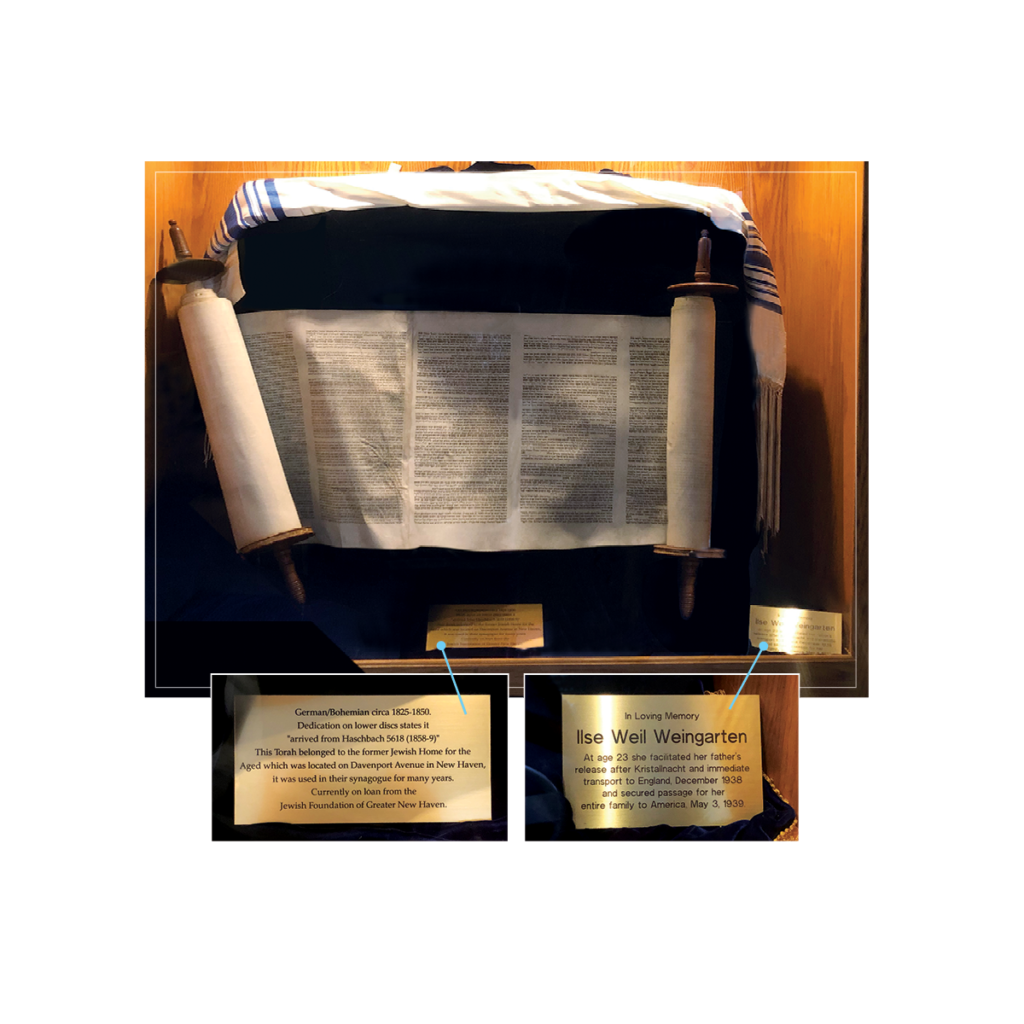
In addition to the Holocaust Torah, Temple Emanuel acquired two Torahs in 1979 from Beth Israel in Derby, and in 1981 from Temple Rodeph Shalom of Ellenville, NY. The Ellenville scroll is a small, in height, Torah. It is glazed so it is heavy and is approximately 100 years old. It is originally from Romania and is currently in our ark along with the Holocaust Torah and a medium sized Torah, on permanent loan from the Jewish Home for the Aged by way of the Jewish Federation. We received this Torah in 2021.
‘medium’ Torah in our portable ark
The Torah scroll from Beth Israel in Derby was originally from Germany and is about 100 years old. It is said to have “beautiful writing” and is housed in a separate portable ark.
The other gift from Beth Israel, is a Polish Torah, approx. 100 years old. After having a scribe repair our Polish Torah, previously in the Rabbi’s office, Rabbi Farbman and a small group from Temple Emanuel escorted the Torah to its new home, Congregation Shir Jadash in Valencia, Spain. Our congregation was proud and pleased to provide this first Torah to a newly formed congregation. The Rabbi was able to conduct a Torah service in its new location on 7/5/25. May it have a long and flourishing life..
Torah scroll on permanent loan
Our final Torah is displayed in TE’s lobby. This Torah is also on loan from the Jewish Home for the Aged through the Jewish Federation. We received it around 2020. It is not kosher as it is not in perfect condition and is unrepairable. While we cannot use it for services it is a welcome reminder of who we are when we enter the Temple. It also provides an up-close view of the text and how a Torah is written.
Some information in this article was gathered from Congregation Beth El’s (Berkeley, CA) website and Temple Emanuel archives and interviews with past and present congregants.
Writing has never been my favorite form of expression. You see, I suffer from writer’s block which often leads to procrastination. My favorite form of communication is meeting and getting to know people in person.
This column is a unilateral activity. I write weeks in advance and don’t get to hear your feedback contemporaneously. Nevertheless, I am expected to write a message. So here it is: Let’s meet and talk in person at TE!
Don’t miss the many upcoming events which fill the pages of this month’s Shofar! From challah baking to our scholar–in–residence series, TE, as always, offers something for everyone! I look forward to meeting and talking to you soon!
As we approach the fourth anniversary of the Covid 19 lockdown and as we look back at the last four years, it is easy to be overwhelmed by what we have all lived through, what we have learned to live with (and, perhaps more importantly, what we have learned to live without) and what challenges we faced. It has taken us all some time to begin to return to ‘normalcy,’ both in our personal lives and especially in our communal lives. We have been back in our sanctuary and our building in person for a while now, even as we continue to live stream our services and events, making sure everyone has access to much of what we do as a community.
We had many exciting plans for this year, and were going to start working on some of them after the High Holy Days— but events of October 7th have stunned us all into a painful and anxious new reality. Every special occasion, every festival, every Shabbat comes with a dilemma: how can I find joy in traditional observances when there’s so much pain and suffering? Chanukkah lights gave us hope, and helped to heal our broken hearts, at least a little—but now with Purim on the horizon, what will our celebrations look like? What stories will we tell at our Seder table this year? How many empty chairs will we have to leave at the table?
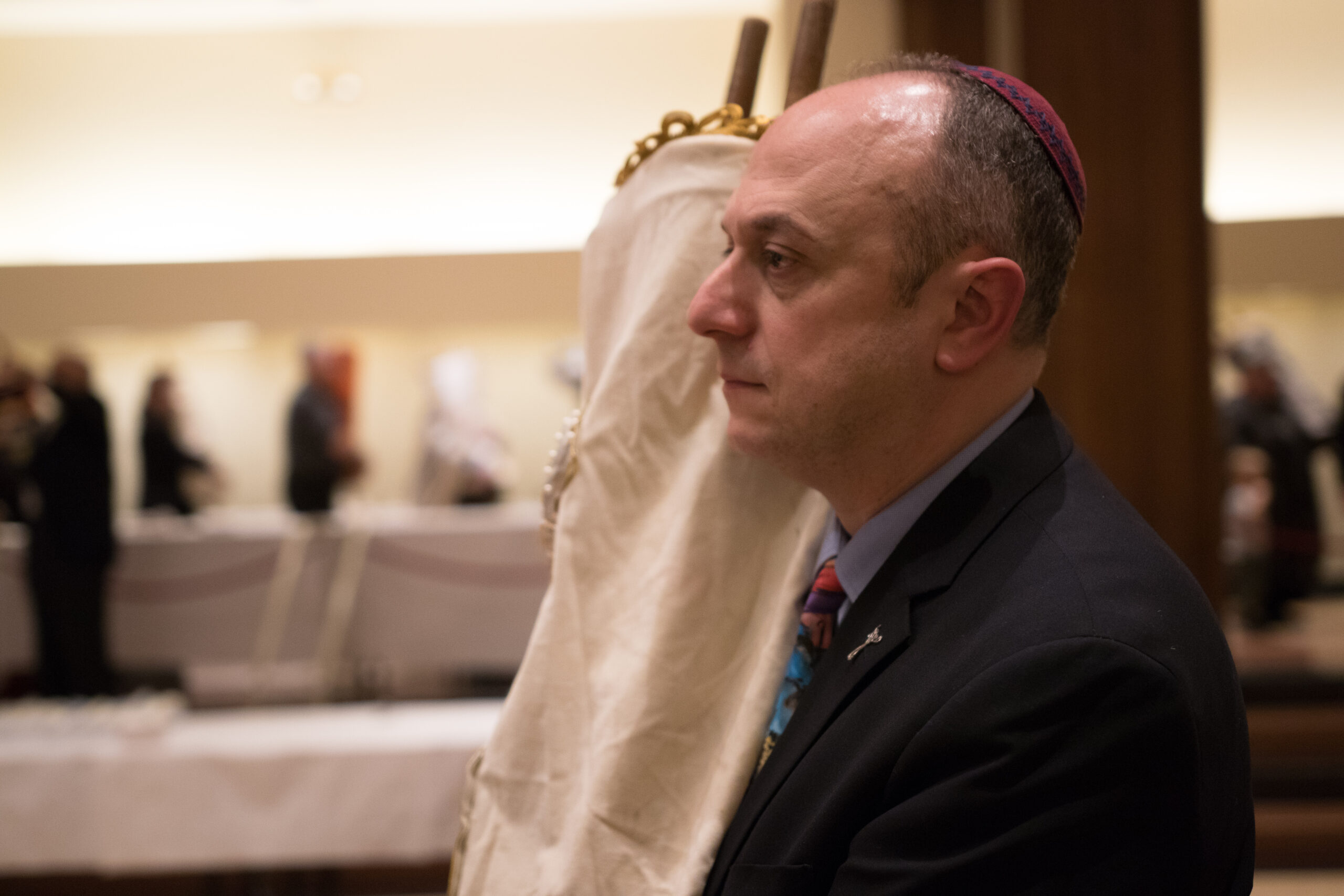
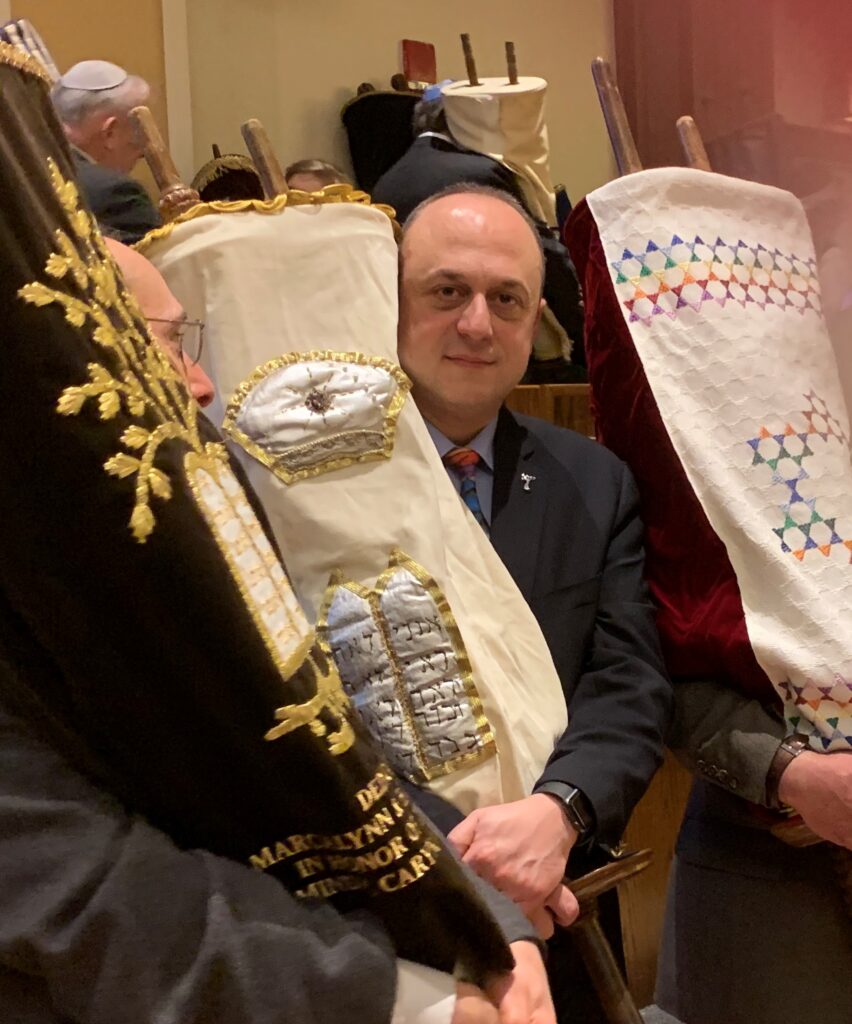
Five years ago, a group of TE members attended a special gathering of the Holocaust Memorial Torah scrolls in New York City, bringing the TE memorial scroll (back then housed in a display cabinet in our lobby) with us. It was a profoundly moving experience. As I held TE’s Holocaust Memorial Scroll #1178, and as I marched in a quiet procession of over 70 Czech memorial scrolls, I was overwhelmed by the fact that in my arms I held not only an incredible treasure of the Jewish people that was created and lovingly maintained by previous generations of Jews I did not know, but a scroll that belonged to the destroyed Jewish community of Horazdovice, a community that perished in the flames of the Holocaust. This was not just the Torah connecting me to the Jewish past. This was a moment to acknowledge, once again, that the future of this Torah’s Jewish community of Horazdovice was wiped out by the cruelty of hate and yet somehow, miraculously, the orphaned Torah has survived and found its way into the loving hands of our community, right here in Orange, CT. Scroll after scroll paraded through the room packed with over 800 people from some 80+ synagogues in the Tri-State area, honoring the painful past and celebrating the miraculous survival of Judaism. I will never forget this moment and this feeling.
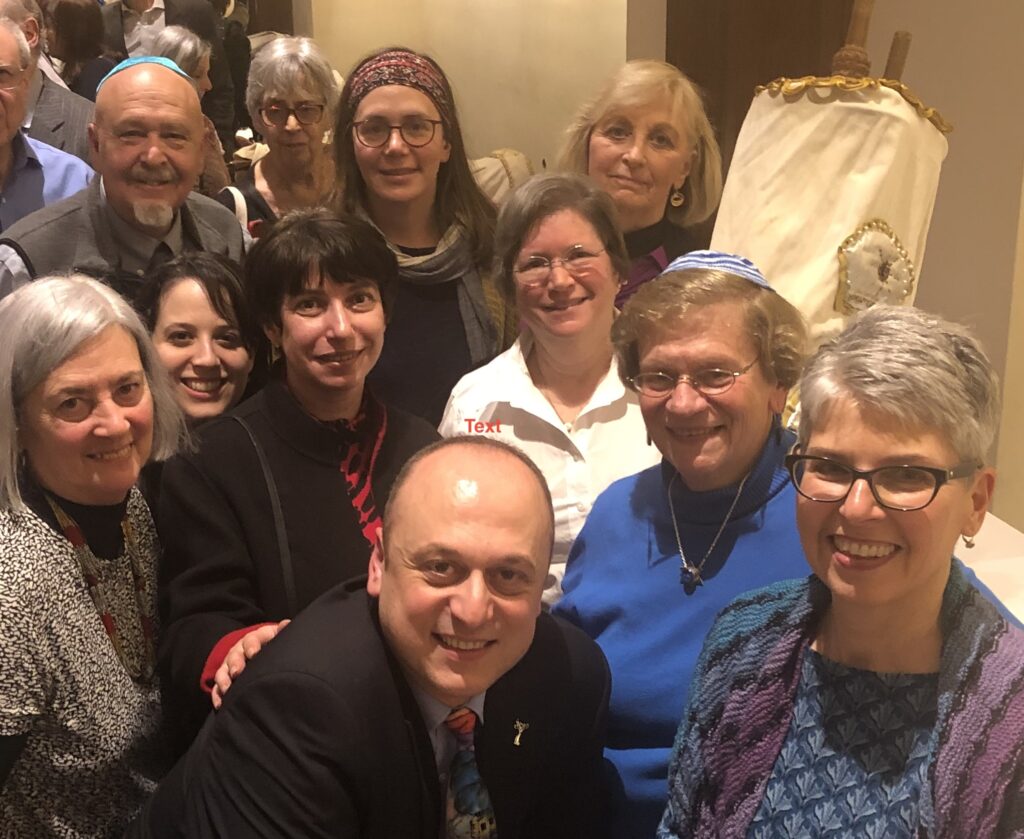
TE delegation with our Memorial Torah Scroll at the gathering in NYC
This year the Memorial Scrolls Trust celebrates its 60th anniversary, and there will once again be a gathering of the Torah scrolls in New York on Sunday, April 7th. This time we will return once again but as I carry our scroll in that procession, it will be a scroll that has been restored and is once again used to celebrate Jewish life as children of our community step up to the Torah celebrating becoming B’nei Mitzvah!
This year, as our calendar begins to fill up with learning opportunities, social gathering opportunities and celebrations, may we continue to be inspired by the story of our Torah scroll, by the resilience of the Jewish people, by our desire to live and build and preserve what we cherish.
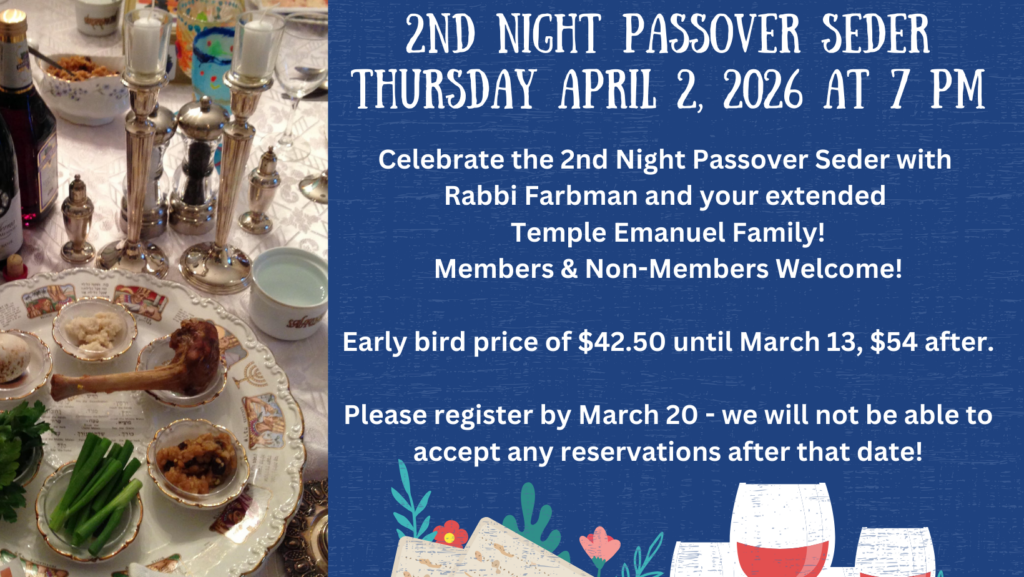
We will learn with Dr. Liram Koblentz-Stenzler, as part of our Annual Scholar–in–Residence Program on March 20th and 27th, and engage in some challenging and timely topics. We will celebrate Purim (including, once again, a special Adult Purim party), and Passover with our Annual Second Night Seder at Temple Emanuel. We will visit the Beinecke rare books collection, and we will plan an opportunity to ice-skate together. We will march proudly with our newly restored Torah scroll, honoring the difficult past, and look towards the future. We will continue to find strength and joy in each other and in sharing our traditions. Am Israel Chai—the People of Israel Lives!
Members of Temple Emanuel at the March for Israel in Washington, DC.
On Tuesday, November 14th, a number of TE members joined the Greater New Haven delegation and traveled to Washington, DC to participate in the March for Israel. It was such a powerful experience, standing with hundreds of thousands of Jews (and some allies) from all over the country, demanding safe return of hostages, renouncing antisemitism, and standing with Israel and with each other. To see so many friends, colleagues, current and former congregants from many different places. To hear words of support. To cry with parents of hostages, demanding to #BringThemHomeNow. It was especially moving to see the little girl working on this sign: ‘my Jewish joy is stronger than your hate.’ I have asked one of the TE march participants, Phoenix Matarazzo, to reflect on our experience:
“Last month, I had the opportunity to participate in the March for Israel with fellow TE members, Rabbi, Olga, and other members of our Greater New Haven Jewish community. It was a day that brought together Jews and allies from various backgrounds, religious observance, and political views. The atmosphere was both somber and joyous. One of the highlights for me was joining everyone in singing “One Day” led by Matisyahu and The Maccabeats. This song always resonates with me because it expresses the deep longing for a future filled with peace. However, it also reminds me that this day of peace is still not here. This yearning for justice and peace was evident throughout the entire day.
As I stood in Washington, I couldn’t help but reflect on our previous school theme of seeing the world through Jewish eyes, and this year’s theme of telling OUR story. What better way to tell our story than by actively participating in it? We are blessed to carry the strength of our ancestors, supporting each other in our happiest and darkest moments. I thought to myself, “We should do this again, during better times!” Perhaps a nationwide Shabbat dinner?
It struck me that this may be the only time in my life that I will get to sing Hatikvah with over 290,000 people. Despite our differences, we are united in our support for the safe return of our kidnapped family members and the protection of our homeland. We are truly one mishpacha, one family.
As I listened and prayed alongside the impressive lineup of speakers and artists, I couldn’t help but believe that we are on the verge of a better world, a new kind of peace, and a stronger unity among the Jewish people. We refuse to yield to the beliefs of our enemies. We stand tall in our own story, proud to live it and pass it on to future generations.
The March for Israel filled me with hope for more acts of kindness, more connection with our traditions and with each other. I hope for more dialogue with our allies and with those who may not yet understand how to be allies. I hope for more education about who we are and where we come from. I hold on to the hope that our mishpacha will be whole again, with all our family members safely home.
When I was young (many years ago), I used to wonder why many of the school holidays came around the same time. We have just gone through a very active period of holidays at Temple Emanuel – Rosh Hashanah, Yom Kippur, Sukkot, and Simchat Torah. With the holidays bunched together, it is a very meaningful period. We as a congregation have had the opportunity to spend much time together. After our long period of being unable to spend much time together, it is wonderful to share time again together.
I like to tinker. After years of trying to change our announcements from stating that we welcome visitors, I recently changed the announcement to welcome newcomers to our community. As you may have noticed over the high holy days, I have changed it once again this time to “family.” I think that more accurately sets forth what Temple Emanuel is – we are a family. We enjoy spending time together and catching up with both old and new friends, or should I say family. And do we ever enjoy participating in the services – for that I thank you.
Many of you know, I love tradition. And I love building on the foundation our predecessors have set up for us. In the coming months we will be discussing new ways to encourage our membership, our family, to be involved with Temple Emanuel. We will also be affording people the opportunity with new ways to be involved with lay leadership at Temple Emanuel. This will involve training and discussions. This teaser will be set forth in greater detail shortly.
I love my TE family. And I know you love it as well. There is a reason why we are growing, when other religious institutions are shrinking. Let us all move to the next level. Thank you.