Counting the Omer…

shavuot aThere is no doubt that the Jewish calendar is designed in a way that can easily confuse just about anyone! I was always absolutely certain of that! J What, with the new year in September (or thereabout – only proving the original statement!) and Chanukah and Passover that fall all over the place… no one can ever figure it out!

I recently asked my Christian colleagues at our local interfaith clergy gathering why the Western and the Orthodox churches sometimes celebrate Easter together and sometimes weeks apart. The answer totally blew me away – because of the Jewish calendar! As it turns out, all churches use the same formula for calculating Easter, but the Eastern (Orthodox) Church also waits for the Passover to take place. Since Passover moves around so much, so does Easter.

If you found yourself agreeing with anything that I said in the first paragraph of this article, you should seriously consider signing up for the Basic Judaism class next time I advertise it! For the Jewish calendar is a very logical and beautifully symmetrical creation, linked to the moon cycle – as well as to the sun – in a very thoughtful and sophisticated way. Much of it is based on the Biblical commandments as well as on the natural cycles of the year and the seasons.  And once you get to know it a little, it’s not THAT complicated J!

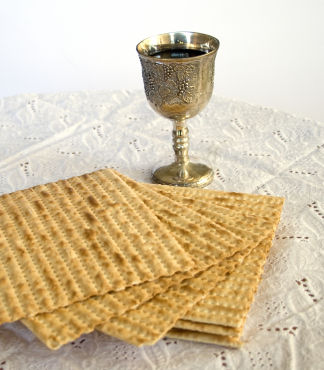
One of the calendar cycles connects the Festivals of Passover and Shavuot through the ritual of Counting the Omer. In fact, the very name of the Festival of Shavuot hints at the cycle – it is best translated as ‘The Festival of Weeks.’ From the second night of Passover, we begin to count the seven weeks, or 7×7 – forty nine days in all, so that on the fiftieth day we can celebrate Shavuot, the festival of first fruits, as well as z’man matan Torateinu, the time of the giving of Torah on Mount Sinai.

So what is the Omer? An ‘omer’ is in fact a sheaf of wheat, a nod to the wheat harvest that would begin around that time of year. And how does one count it? A few years ago I came across a very clever website that referred to it as ‘counting the Homer’ – making the age-old ritual connected to the Simpsons! It gives the basic information about counting, as well as providing the blessings to be recited on each day in the run-up to Shavuot. You can try it for yourself! Just go to www.homercalendar.net and enjoy.

This year Shavuot begins in the evening on Tuesday, May 30th. As we celebrate the giving of Torah, we come together to pray and to study – please make sure you check the calendar and Shofar Blast for more details nearer the time. We also follow the Reform tradition of holding the Confirmation service on Shavuot, celebrating our wonderful teenagers who have completed their two-year long course of study with me by helping to lead the Shavuot service and read the 10 commandments from the Torah. I know that when festivals fall mid-week it makes it harder for many people to attend, but I want to encourage you all to do so and come celebrate this very special Festival together with your TE family. See you there!

Rabbi Farbman

Parts of this article previously appeared in the Shofar in 2011.

Change, Commitment & Continuity—A Tale in 3 parts. Part 3: L’dor v’dor


Melissa at BiennialChange:  Amazingly, this is my last column as I finish my term as President at Temple Emanuel.  It has been a privilege to serve, and moreover, to have one’s service accepted. I am humbly grateful to Temple Emanuel for the sacred opportunity to have helped lead TE over the last three years. In addition, it has been three years of change and growth. From completion of the Jonas and Barbara Miller education wing, to the replacement of the old HVACs, and placement of the solar panels, we have done lots of work on the physical plant of our TE home. We have strengthened our school with a part time director, improved our bookkeeping system, and started our Federation Endowment and Legacy funds. Even more importantly, we have added families, staff, and programs that make our TE home a place where people want to come, learn, share, and experience Judaism.

Commitment: Without the commitment of our many TE members over these last several years nothing would have gotten done. I would like to acknowledge with deep appreciation the truly generous support I have gotten from my fantastic fellow members as we have journeyed together. A very smart editor of the Shofar once counseled me that if I list names, I will undoubtedly leave off one or two of the most important. I have tried to heed her warning. But, I can say that I have been blessed by the amazing help of the TE Board and officers, the Rabbi, the director of the school, the bookkeeper, the office administrator, and the caretaker. But it is all the other members who teach, head events, champion causes, raise funds, do publicity and communications, create beauty (outside and in), cook, schlepp, and otherwise provide the real hands on work that I am most grateful to. We are a community of “do-ers”.

Continuity:  I am optimistic that we are a growing community on the move. Come help be part of that energy that moves us.  The Annual meeting is on June 11; besides the bagels, you will have the opportunity to voice your opinion and vote for the budget, the slate of officers, and the new Board members for the coming year. It is a group of individuals that are ready and able to continue our success. L’dor v’dor

TE Men’s Club presents: Caring for the Aging Parent and Caring for the Caregiver. Sunday, April 2 at 3 pm.

Terri FriedThis session will address the issues that adult children commonly face when helping to care for an aging parent: memory loss and dementia, trade-offs between safety and independence, planning for difficult medical decisions. The session will also address the need for caregivers to take care of themselves. There will be lots of time for questions and discussion.

The session will be led by Terri Fried, MD. Terri is a Professor at the Yale School of Medicine and co-director of the Yale Pepper Center, an interdisciplinary research program devoted to improving the health and quality of life for older adults. She is an attending physician in geriatrics at the VA Connecticut Healthcare System and has grants from the NIH and the VA to conduct research on advance care planning and on the care of the older adults with multiple medical conditions.

Sunday, April 2nd at 3pm.

Tot Shabbat service, Friday March 24 at 5:30 pm

Tots Shabbat is always fun!

Come celebrate Shabbat with Rabbi Michael in the beautiful TE sanctuary with songs and stories! Perfect for children under 5 and their families. Members and non-members welcome!

The Tot Shabbat service on Friday, March 24 at 5:30 pm will be followed by Shabbat dinner (to welcome our Scholar in Residence Dr. Alan Morinis of the Mussar Institute), allowing congregants of all ages to interact and enjoy the meal! We will have some teens to help out during dinner, allowing parents a chance to get to know more adults at TE.
To register for dinner, please follow this link.

Spring is in the air…

Rabbi Farbman-photoSpring is in the air; the month of Adar is here – and it can only mean one thing: Purim is coming! Got your costumes? Ready to party? We got big plans on Sunday morning (March 12), so bring your family and friends! However, Purim is not just for children at TE – the Saturday night (March 11) adult Purim party should be great fun too! And once we are done with Purim, Pesach is just around the corner – with all the excitement of spring cleaning and cooking and, of course, the Seders and family time. Our annual 2nd Night Passover Seder is on April 11th this year – an opportunity to celebrate this special holiday with your extended TE family and friends. Please make sure you sign up in advance!

The TE calendar is filled with exciting opportunities this spring, as in-between the festivals and programs we get to welcome Dr. Alan Morinis to Temple Emanuel as our Scholar in Residence – a true master teacher and an incredible opportunity for all of us to learn more about the Mussar tradition that he teaches so well.

Time flies quickly, and while the High Holy Days are still a long way away (no rush!:), our ritual committee is hard at work, looking for ways to explore Mishkan HaNefesh, the High Holy Day Machzor, published by the Reform movement last year. Two focus group discussions are scheduled in March (Sunday March 5th at 10 am and Tuesday, March 21 at 6:30pm). I strongly encourage you to attend one of them and get involved in this important conversation.

It is fun to plan ahead and look forward to whatever is the next big event or occasion. But as we plan for the future, let’s all find some time to appreciate the wonderful present. See you soon, I hope – at a regular shabbat service, Hebrew school, or committee meeting!

Change, Commitment & Continuity—A Tale in Three Parts. Part 2.


Melissa at BiennialChange:  There could be little doubt that we are in a time of change (no matter what your political sentiment) and that change can be unsettling. I find that when things are very far out of my control or are difficult or troubling that by acting on a very small, local level it is possible to affect change and feel better about the world. Temple Emanuel has many ways for you to be involved in improving the world on a local level, and it can start with tzedakah.

Commitment: The Jewish ideals of tzedakah were summarized and taught by Moses Maimonides, a great teacher who lived in Spain during the 12th century CE. Maimonides believed that tzedakah is like a ladder with eight rungs; each successive rung represents a higher form of giving. They are:

  1. The person who gives reluctantly and with regret.
  2. The person who gives graciously, but less than one should.
  3. The person who gives what one should, but only after being asked.
  4. The person who gives before being asked.
  5. The person who gives without knowing to whom he or she gives, although the recipient knows the identity of the donor.
  6. The person who gives without making his or her identity known.
  7. The person who gives without knowing to whom he or she gives. The recipient does not know from whom he or she receives.
  8. The person who helps another to become self-supporting by a gift or a loan or by finding employment for the recipient.

Continuity:   For Jews, the Talmud instructs that assisting the poor is not an act of grace on the part of the donor, but a duty. We are all obligated to give (even if we receive). So where will you help – with toiletries and diaper bank donations that the Men’s Club is organizing, with Abraham’s Tent that TE is participating in, with money or a job for one of our JCARR families that we are helping to resettle?  Please reach out and continue to make the change in the world that you want to see.

Temple Emanuel’s Megilla reading and Adult Purim Karaoke Party – Saturday, March 11 at 7 pm

Purim 2017

A fun Megillah Reading and celebration of Purim open to everyone, followed by an exclusive adults-only Purim party (21+ and ticket required) – Wear your Purim costumes!

Register for the party in advance – $18 per person. Tickets at the door will be available for $20 per person, so don’t delay – register today!