
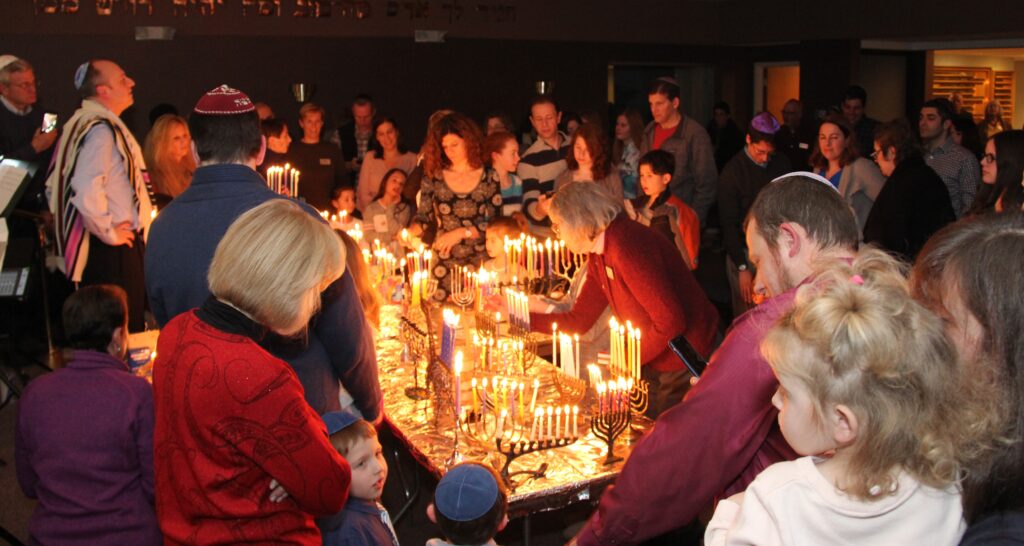
There is a disagreement in the Talmud about how we should light the Chanukkah candles. Shammai and Hillel, the two leading scholars of their time, agree on the essentials: we are to light candles for the eight nights of Chanukkah. But they disagree about how we should do it.
Shammai says we should begin with eight candles and light one fewer each night. Eight on the first evening, seven on the second, six on the third, until we reach just one on the final night. We can imagine the practical logic behind this approach by returning to the story of the oil. The Temple has been reclaimed, but there is only enough pure oil to keep the menorah burning for one day. The miracle is that this small supply lasts for eight. Seen from this perspective, Shammai’s approach makes sense: begin with the fullness of the miracle, then reduce the number of lights each evening, as though the supply of oil were gradually running down. We start with eight and count towards one.
It is a perfectly logical approach. We begin with the full measure of the festival and gradually count down towards its end. But Hillel sees things differently. He says we should begin with one candle and add another each night: one, then two, then three, until all eight are burning together on the final evening. His reasoning is expressed in a principle that reaches well beyond the lighting of candles: ma’alin bakodesh v’ein moridin—in matters of holiness, we increase rather than decrease.
We add light. We don’t take it away.
The Talmud preserves both opinions, but the practice we follow is that of Hillel. And I think there is something quietly powerful in that choice. The same eight-day festival can be understood in two ways. We can count down the days that remain, watching the number of candles diminish. Or we can count what has accumulated, adding another flame each evening until the light is at its fullest.
The darkness outside hasn’t changed. December is still December. The days are short, the nights are long, and the cold has a habit of reminding us that winter is not merely a metaphor. Nor does the world conveniently become a happier, more peaceful place just because Chanukkah has arrived. In fact, Chanukkah is hardly a story of effortless happiness. At its heart is a struggle: a community confronting oppression, fighting to preserve its way of life, and rededicating its Temple after it has been desecrated. The familiar story of the oil lasting eight days adds a miracle to the narrative, but the festival also remembers people who had to struggle to reclaim something precious to them. The light of Chanukkah is not the light of a world in which everything is well. It is the light that people bring into a world in turmoil.
Perhaps that is why Hillel’s approach speaks to us so powerfully. We don’t wait for the darkness to lift before we light another candle. We don’t require certainty that our efforts will succeed. We don’t even need to know how much difference one small flame will make. We simply recognize that adding light is better than allowing it to diminish.
This is what I find so compelling about the Chanukkah candles. Their light is not magical in the sense that it makes our difficulties vanish. It is meaningful because we choose to kindle it, and because we return to do so again the following evening. The ritual asks us to participate in bringing light into the world, rather than simply waiting for it to arrive.
As we gather this Chanukah, I hope we will enjoy the candles, the songs, the latkes, and the company of family and friends. There is nothing wrong with a little seasonal sparkle. But perhaps we can also remember the more demanding message beneath the familiar glow. We are not promised a world without darkness. We are asked what we will do in the presence of it. Hillel’s answer is to add another candle. And then another.
We may not be able to light the whole world. But we can choose not to let the light diminish. We can bring what light we have, where it is needed, and keep adding to it—one small flame, one act of kindness, one day at a time. That is not a magical solution to the world’s problems. It is the beginning of the work.